
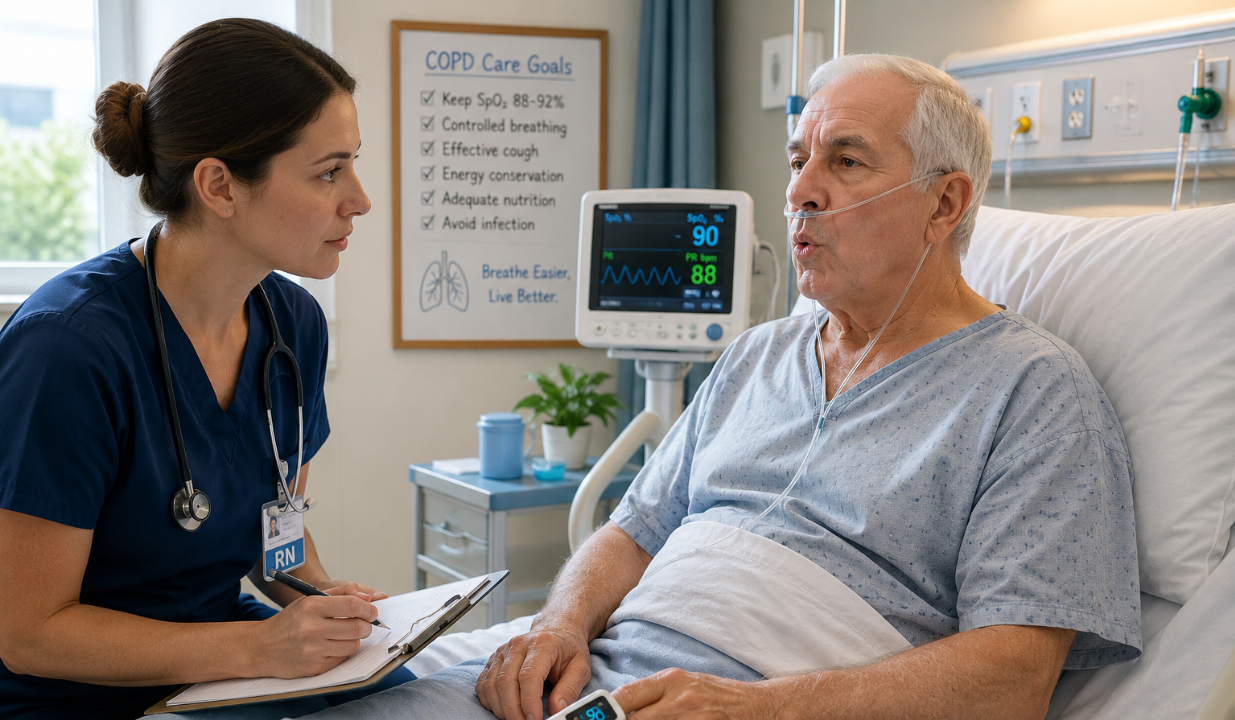
Your patient has COPD. That is the easy part, because COPD is the medical diagnosis. The hard part is the next decision: which nursing diagnoses fit this patient’s actual response right now, the retained secretions, the low oxygen, the fatigue, or the fear of not being able to breathe. Most COPD patients fit several at once, and the real skill is prioritizing them.
Keep the distinction front and center. COPD is the medical diagnosis. Nursing diagnoses describe how this patient is responding to it: ineffective airway clearance, impaired gas exchange, activity intolerance, and more. This guide walks you through how to choose them from the assessment, how to prioritize with the ABCs, how to handle the oxygen question every student gets wrong, and how to build a care plan with goals you can measure.
Bottom line: COPD is the medical diagnosis; the nursing diagnoses come from your assessment cues. Ineffective airway clearance (secretions) and impaired gas exchange (oxygenation and carbon dioxide) are usually the top priorities. Titrate oxygen to 88 to 92 percent in patients who retain carbon dioxide; never withhold it, but never crank it blindly. Do not overlook nutrition, anxiety, and infection.
In This Article:
- What COPD means in a care plan
- Nursing diagnosis vs. medical diagnosis
- Assessment data to collect first
- How to choose and prioritize the diagnosis
- Priority nursing diagnoses for COPD
- The oxygen question every student gets wrong
- COPD exacerbation: red flags and when to escalate
- How to prioritize
- A worked patient scenario
- Sample care plan table and interventions
- Patient education, common mistakes, and example PES statements
What COPD Means in a Nursing Care Plan
COPD is a chronic, progressive airflow disease that causes permanent damage to the lungs and narrows the airways. The airflow limitation is persistent and cannot be fully reversed by medications. This permanent trapping of air is confirmed by a spirometry test showing a post-bronchodilator FEV1/FVC below 0.70. For your care plan, focus on how this trapped air affects the patient. The underlying damage to the airways causes a cluster of responses: secretions, poor gas exchange, breathlessness with effort, and weight loss. Your job is to prioritize the problems one by one.
Students are often tested on recognizing how COPD presents in a patient. Knowing the two classic clinical presentations will confirm your assessment.
The cardinal signs of COPD (present in all types):
- Progressive dyspnea: progressively worse over time and worse on exertion.
- Chronic cough: can be productive or non-productive.
- Sputum progression: can be constant or recurring.
| Feature | Chronic bronchitis (“blue bloater”) | Emphysema (“pink puffer”) |
|---|---|---|
| Pathophysiology | Chronic airway inflammation and narrowing | Permanent alveolar wall destruction and loss of lung elasticity |
| Main air-trapping mechanism | Alveoli are physically obstructed by mucus | Alveoli lose shape and collapse |
| Chest assessment | Coarse crackles, rhonchi, wheezing | Barrel chest, hyperresonance with percussion |
| Breathing mechanics and posture | Initial normal respiratory drive | Prolonged expiratory phase, tripod position, pursed-lip breathing |
| Systemic and skin signs | Cyanosis and dusky | No change in skin color until late cyanosis |
| Nutritional signs | Weight is stable, edema if right-sided heart failure | Severe weight and muscle loss |
| Key secondary characteristics | Early hypoxemia and hypercapnia; high risk for heart failure | Late-stage hypoxemia, severe respiratory failure develops |
Note: Most patients present with features of both chronic bronchitis and emphysema. Use this table as a tool to understand the difference in the pathophysiology, which drives the treatment.
COPD severity is also staged by spirometry.
| GOLD stage | Severity | FEV1 (% predicted) |
|---|---|---|
| GOLD 1 | Mild | 80 percent or higher |
| GOLD 2 | Moderate | 50 to 79 percent |
| GOLD 3 | Severe | 30 to 49 percent |
| GOLD 4 | Very severe | Less than 30 percent |
Note: Modern GOLD also groups patients by symptoms and exacerbation risk (the A, B, and E groups, using tools such as the mMRC dyspnea scale and the CAT score), which drives treatment.
Important: A COPD exacerbation with severe breathlessness, confusion, an SpO2 that does not respond, cyanosis, or rising drowsiness (which can signal carbon dioxide narcosis) is an emergency. Escalate per protocol.
Nursing Diagnosis vs. Medical Diagnosis
The medical diagnosis is COPD, along with complications such as pneumonia, cor pulmonale, or an acute exacerbation. The nursing diagnoses describe the patient’s response: ineffective airway clearance, impaired gas exchange, ineffective breathing pattern, activity intolerance, imbalanced nutrition, anxiety, and deficient knowledge.
Here is the key move. Do not pick a diagnosis just because the chart says COPD. The same patient supports different diagnoses depending on the assessment. Thick retained secretions point one way; a low SpO2 and an abnormal ABG point another.
Three short examples:
- A patient who cannot clear thick sputum fits ineffective airway clearance.
- A patient with an SpO2 of 85 percent and an abnormal ABG fits impaired gas exchange.
- A patient who is breathless after walking to the bathroom fits activity intolerance.
Assessment Data to Collect First
The diagnosis comes after the assessment. Document both what the patient reports and what you measure.
Subjective cues: breathlessness (have the patient rate it; the mMRC dyspnea scale is a useful tool), fatigue, reduced exercise tolerance, anxiety or a fear of suffocation, appetite and weight changes, sleep disruption, and smoking history.
Objective cues: respiratory rate, depth, effort, and the prolonged expiratory phase; accessory muscle use and pursed-lip breathing; breath sounds (wheezes, rhonchi, diminished); the SpO2 trend and the ABG (often a chronically compensated respiratory acidosis); cough and sputum (amount, color, consistency); a barrel chest; clubbing; cyanosis; signs of right-sided heart failure (peripheral edema, jugular venous distention); mental status; and weight and nutritional status.
Tests you may review include spirometry and pulmonary function tests, an ABG, pulse oximetry, a chest X-ray, a CBC (polycythemia can develop from chronic hypoxia), a sputum culture during exacerbations, and a BNP if heart failure is suspected.
Group related cues before you commit to a label:
- Thick retained sputum plus coarse crackles plus a weak cough points to ineffective airway clearance.
- A low SpO2 plus an abnormal ABG plus restlessness points to impaired gas exchange.
- A prolonged expiration plus accessory muscle use plus tachypnea points to ineffective breathing pattern.
- Dyspnea plus fatigue plus desaturation with activity points to activity intolerance.
How to Choose and Prioritize the COPD Nursing Diagnosis
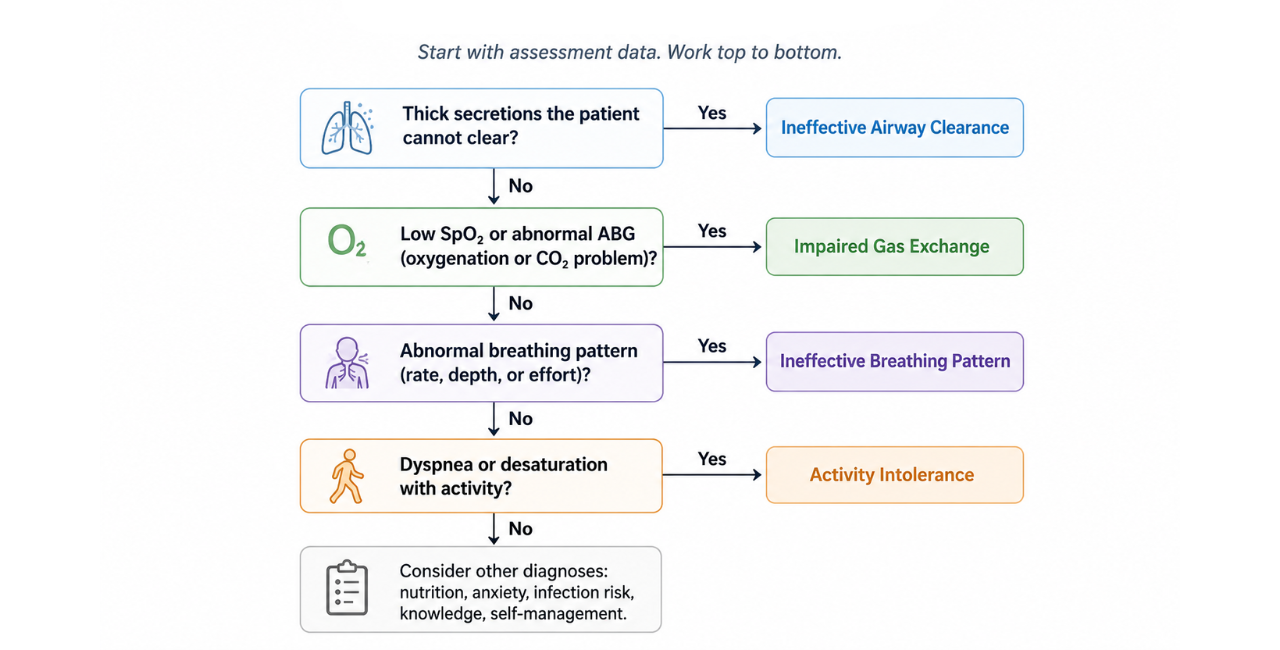
The best way to prioritize is to use a step-by-step approach built on your clinical judgment. Work it top to bottom.
- Is the airway blocked by secretions the patient cannot clear? Consider ineffective airway clearance, often first.
- Is oxygenation or carbon dioxide the problem, shown by an abnormal SpO2 or ABG? Consider impaired gas exchange.
- Is the breathing pattern itself the problem, the rate, depth, or rhythm? Consider ineffective breathing pattern.
- Does activity trigger dyspnea and desaturation? Consider activity intolerance.
- Is the patient losing weight or underfed? Consider imbalanced nutrition.
- Is fear driving the dyspnea? Consider anxiety.
- Does the patient not understand inhalers, oxygen, or warning signs? Consider deficient knowledge.
Prioritize with the ABCs. Airway clearance and gas exchange usually come first because they are immediately threatening, then breathing pattern, then activity tolerance, nutrition, anxiety, and finally education and long-term self-management.
Note: A patient often carries several of these at once. The list below is roughly in priority order, but your assessment decides.
Priority Nursing Diagnoses for COPD
These are chosen from the assessment, not by default. Each one follows the same pattern so you can quickly decide whether your assessment data supports it: when it fits, the cues, a sample PES statement, and the student mistake to avoid.
Ineffective Airway Clearance
Often the top priority in chronic bronchitis. Use it for thick, retained secretions, a weak or ineffective cough, coarse crackles, and rhonchi. Interventions: hydration to thin secretions, controlled or huff coughing, positioning, chest physiotherapy, suctioning when needed, and bronchodilators. Sample PES statement: “Ineffective airway clearance related to excessive thick secretions and bronchospasm as evidenced by coarse crackles, a weak productive cough, and an SpO2 of 89 percent.” Common mistake: confusing it with impaired gas exchange when the real issue is moving mucus.
Impaired Gas Exchange
Use this when oxygenation or carbon dioxide elimination is the problem: a low SpO2, an abnormal ABG, cyanosis, restlessness, or confusion. This is where the oxygen-titration safety point lives, covered in its own section below. Sample PES statement: “Impaired gas exchange related to alveolar-capillary membrane changes as evidenced by an SpO2 of 84 percent, an ABG showing respiratory acidosis, and restlessness.” Common mistake: choosing it without an abnormal ABG or SpO2 to back it.
Ineffective Breathing Pattern
Use this when the mechanics are abnormal: a prolonged expiration, accessory muscle use, tachypnea, or an inability to coordinate breathing. Interventions: pursed-lip and diaphragmatic breathing, positioning, and pacing.
Activity Intolerance
Use this when dyspnea, fatigue, or desaturation limit activity. Focus on graded activity, monitoring the SpO2 with exertion, energy conservation, rest periods, and pulmonary rehabilitation, not generic “exercise more” advice.
Imbalanced Nutrition: Less Than Body Requirements
Often the missing piece. Many COPD patients are underweight: the work of breathing burns calories, and breathlessness makes eating hard. Interventions: small, frequent, high-calorie and high-protein meals, rest before meals, supplemental oxygen during meals if needed, and a dietitian referral.
Anxiety
Air hunger triggers fear, and fear worsens dyspnea in a vicious cycle. Use this when anxiety or panic is a clear cue. Interventions: a calm presence, coached pursed-lip breathing, clear explanations, and reducing the work of breathing.
Risk for Infection
COPD patients are prone to respiratory infections that trigger exacerbations. Interventions: vaccination (influenza and pneumococcal), hand hygiene, sputum monitoring, and early recognition of infection. A risk diagnosis uses risk factors only and no “as evidenced by.”
Deficient Knowledge or Readiness for Enhanced Health Management
Use deficient knowledge when the patient misunderstands inhaler technique, oxygen use, or warning signs. Use readiness for enhanced health management for a motivated patient who is improving self-care, quitting smoking, or participating in pulmonary rehab. A health-promotion diagnosis rounds out the taxonomy.
The COPD Oxygen Question Every Student Gets Wrong
This is the single highest-yield COPD safety point. Some COPD patients retain carbon dioxide over time, which changes how their bodies regulate breathing. Instead of relying mainly on carbon dioxide levels to trigger a breath, their bodies start using oxygen levels as the signal. Because of this shift, giving too much oxygen too quickly can make their breathing slow down and can worsen carbon dioxide retention. So the usual oxygen target is a lower SpO2 of 88 to 92 percent, titrated to the lowest effective flow, rather than 94 to 98 percent.
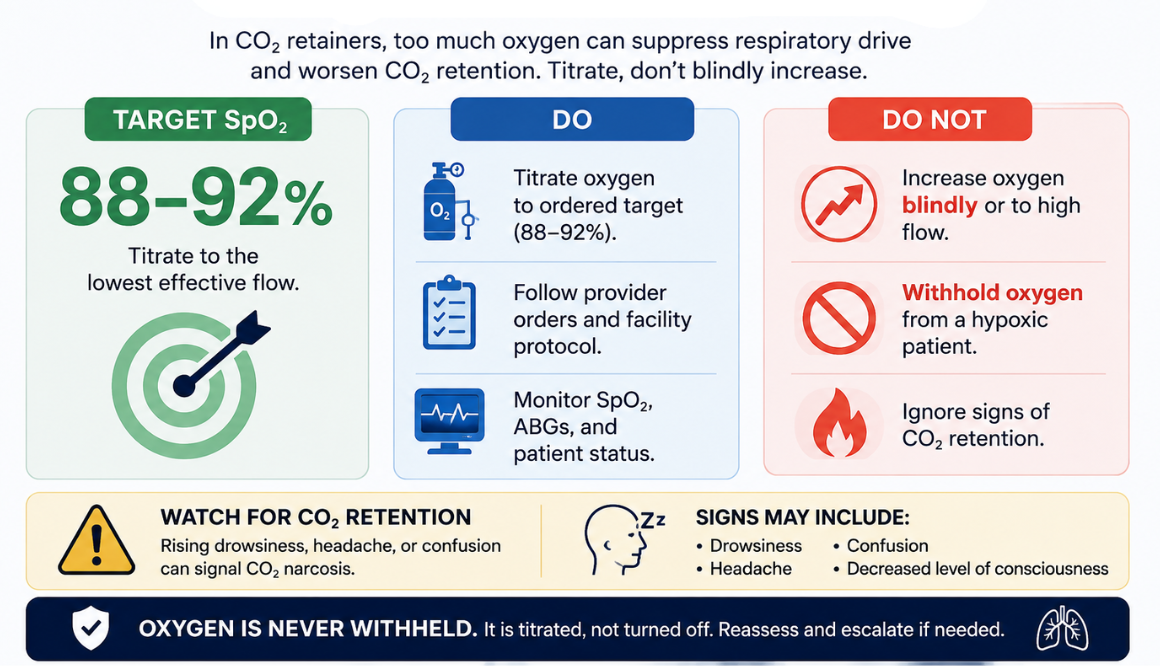
Here is the reasoning in plain language. Too much oxygen can worsen the mismatch between ventilation and perfusion in the lungs, and high-flow oxygen can blunt the respiratory drive in a retainer. But oxygen is never withheld from a hypoxic patient. It is titrated, not turned off. Targets are individualized and ordered by the provider, so follow facility protocol.
Important: Rising drowsiness, headache, or confusion can signal carbon dioxide narcosis. Reassess and escalate; do not simply increase the oxygen.
COPD Exacerbation: Red Flags and When to Escalate
Keep these warning signs in one place. Escalate early when you see them.
- Increased dyspnea
- Increased sputum volume
- A change in sputum color to yellow, green, or brown (the cardinal Anthonisen signs)
- Fever
- A rising respiratory rate
- A falling SpO2 that does not respond to oxygen
- New confusion or drowsiness
- Cyanosis
- Accessory muscle use at rest
- An inability to speak in full sentences
What the nurse does: reassess airway and oxygenation, position the patient upright, deliver bronchodilators and oxygen per orders, anticipate steroids and antibiotics, prepare for noninvasive ventilation if ordered, and escalate early.
How to Prioritize
When a patient carries several diagnoses, order them with the ABCs, safety, and Maslow in mind.
- First: airway and breathing emergencies. A severe exacerbation, carbon dioxide narcosis, or refractory hypoxia. Escalate.
- Second: airway clearance and gas exchange.
- Third: breathing pattern and activity tolerance.
- Fourth: nutrition, anxiety, infection prevention, education, and long-term self-management.
This is the Next Generation NCLEX clinical-judgment cycle: recognize cues, analyze and prioritize, take action, and evaluate. The oxygen-titration scenario is a classic clinical-judgment example.
A Worked Patient Scenario
A 70-year-old with a 40-pack-year history is admitted with a COPD exacerbation. The patient has a productive cough with thick yellow sputum, a respiratory rate of 26, an SpO2 of 84 percent on room air, audible wheezes, and accessory muscle use, and is anxious and unable to finish sentences. The ABG shows pH 7.34, PaCO2 58, and HCO3 30.
Walk it through. The cues cluster into a secretion story (thick yellow sputum, a productive cough), an oxygenation story (the low SpO2 and the ABG), and an anxiety story (unable to finish sentences, frightened). The ABG is a compensated respiratory acidosis, the chronic COPD picture, now acutely worse.
The top candidates are ineffective airway clearance, impaired gas exchange, and anxiety. Because the patient cannot move the mucus that is driving the obstruction and the desaturation, ineffective airway clearance and impaired gas exchange lead together, with anxiety close behind. The correct oxygen target here is 88 to 92 percent, titrated, not high-flow. A sample SMART goal: the patient will maintain an SpO2 of 88 to 92 percent on the ordered oxygen and produce an effective cough within the hour.
Interventions: titrate oxygen to target, position upright, give bronchodilators per orders, encourage controlled coughing and hydration, coach pursed-lip breathing to ease the anxiety and air trapping, and anticipate steroids and antibiotics. Evaluate against the SpO2, the respiratory rate, the sputum clearance, and the patient’s mental status.
Sample COPD Nursing Care Plan Table
| Nursing diagnosis | Supporting cues | Short-term goal | Long-term goal | Nursing interventions | Rationale | Evaluation |
|---|---|---|---|---|---|---|
| Ineffective airway clearance | Thick sputum, coarse crackles, weak cough | Produces an effective cough this shift | Maintains a clear airway | Hydration, controlled coughing, positioning, suctioning as needed | Thinner secretions and an effective cough open the airway | Clearer breath sounds, productive cough |
| Impaired gas exchange | SpO2 84 percent, abnormal ABG, restlessness | SpO2 88 to 92 percent on ordered oxygen | Maintains adequate oxygenation | Titrate oxygen to target, monitor ABG and SpO2, Venturi mask for precision | Careful titration corrects hypoxia without suppressing drive | SpO2 and ABG at target |
| Ineffective breathing pattern | Prolonged expiration, accessory muscle use, RR 26 | Breathes with less effort using pursed-lip technique | Sustains an effective pattern | Pursed-lip and diaphragmatic breathing, upright positioning, pacing | Pursed-lip breathing reduces air trapping | Respiratory rate and effort improve |
| Activity intolerance | Dyspnea and desaturation with exertion | Completes ADLs with rest periods, no severe desaturation | Tolerates planned activity | Graded activity, SpO2 monitoring, energy conservation | Pacing keeps oxygen demand within supply | Meets activity goal safely |
| Imbalanced nutrition: less than body requirements | BMI 17, early satiety, weight loss | Eats small frequent meals and gains intake | Maintains adequate weight and intake | High-calorie, high-protein meals, rest before meals, dietitian referral | Meeting energy needs supports respiratory muscle strength | Intake and weight trend up |
Nursing Interventions for COPD
Group interventions by purpose instead of repeating them under each diagnosis, and give the reason each one matters.
Airway clearance and secretion management. Hydration within cardiac tolerance to thin secretions, controlled or huff coughing, positioning, incentive spirometry, chest physiotherapy, and suctioning when needed. The reason: clearing mucus opens the airways and improves ventilation.
Oxygen therapy and gas exchange. Titrate oxygen to the ordered target, commonly 88 to 92 percent in COPD, monitor the SpO2 and ABG trends, and use humidified oxygen and the right device (a Venturi mask gives a precise FiO2). The reason: careful titration corrects hypoxia without suppressing the respiratory drive.
Breathing techniques and positioning. Pursed-lip and diaphragmatic breathing, the tripod or orthopneic position, and elevating the head of the bed. The reason: pursed-lip breathing reduces air trapping and improves oxygenation, and upright positioning eases the work of breathing.
Medications. Short- and long-acting bronchodilators (beta-agonists and antimuscarinics), inhaled and systemic corticosteroids, mucolytics, and antibiotics for an infective exacerbation. Teach correct inhaler and spacer technique, and mouth rinsing after inhaled steroids to prevent thrush. The nurse’s role is administration and monitoring the response.
Activity, pulmonary rehab, and energy conservation. Graded activity with SpO2 monitoring, scheduled rest, energy-conservation techniques (sitting to do tasks, keeping items within reach, pacing), and a referral to pulmonary rehabilitation. The reason: conditioning and pacing improve tolerance and quality of life.
Nutrition support. Small, frequent, calorie- and protein-dense meals, rest before eating, supplemental oxygen during meals if needed, avoiding gas-producing foods, and a dietitian referral. The reason: meeting energy needs supports respiratory muscle strength and immunity.
Infection prevention and exacerbation monitoring. Vaccinations, hand hygiene, sputum monitoring, and teaching the cardinal exacerbation signs. The reason: preventing and catching infection early reduces exacerbations and hospitalizations.
Education, smoking cessation, and discharge. Smoking cessation (the single most important intervention), inhaler technique, home oxygen safety, an action plan for worsening symptoms, follow-up, and teach-back to confirm understanding.
Patient Education Points
- Quit smoking, and avoid secondhand smoke and pollutants; ask about cessation support.
- Use inhalers and spacers correctly, and rinse your mouth after inhaled steroids.
- Use home oxygen exactly as prescribed; never increase the flow on your own, and keep oxygen away from open flames.
- Practice pursed-lip and diaphragmatic breathing, and pace activities with rest periods.
- Eat small, frequent, high-calorie and high-protein meals, and stay hydrated.
- Get the influenza and pneumococcal vaccines.
- Know the exacerbation warning signs (more breathlessness, more or discolored sputum, fever) and your action plan for when to call or seek care.
Common Mistakes Nursing Students Make
- Cranking oxygen to high flow in a carbon-dioxide-retaining COPD patient instead of titrating to 88 to 92 percent.
- Picking a diagnosis just because the chart says COPD, without matching it to assessment cues.
- Confusing ineffective airway clearance (secretions) with impaired gas exchange (oxygenation and carbon dioxide).
- Defining only chronic bronchitis or only emphysema instead of contrasting both.
- Writing a vague goal like “patient will breathe better” instead of a measurable, time-bound outcome.
- Writing interventions without rationales, or listing provider orders without the nurse’s role.
- Adding “as evidenced by” to a risk diagnosis such as risk for infection.
- Overlooking nutrition and anxiety, which strongly affect COPD outcomes.
- Failing to reassess and evaluate whether the interventions worked.
Example PES Statements
These are examples only. Every statement has to match your own patient’s assessment data.
- Ineffective airway clearance related to excessive thick secretions and bronchospasm as evidenced by coarse crackles, a weak productive cough, and an SpO2 of 89 percent.
- Impaired gas exchange related to alveolar-capillary membrane changes as evidenced by an SpO2 of 84 percent, an ABG showing respiratory acidosis, and restlessness.
- Ineffective breathing pattern related to airflow limitation and air trapping as evidenced by a prolonged expiration, accessory muscle use, and a respiratory rate of 26.
- Activity intolerance related to an imbalance between oxygen supply and demand as evidenced by dyspnea and desaturation to 86 percent after walking 10 feet.
- Imbalanced nutrition: less than body requirements related to increased work of breathing and early satiety as evidenced by a BMI of 17 and unintentional weight loss.
- Risk for infection related to retained secretions and chronic airflow limitation (risk diagnosis: risk factors only, no “as evidenced by”).
Free COPD Nursing Care Plan Worksheet
You can practice the full reasoning chain with our COPD care plan worksheet, which walks you from cues to a priority diagnosis, the correct oxygen target, and a measurable goal. COPD Nursing Care Plan Worksheet
Key Takeaways
- COPD is the medical diagnosis; the nursing diagnoses describe the patient’s response and are chosen from assessment cues.
- Ineffective airway clearance and impaired gas exchange are usually the top priorities; distinguish them by secretions vs. oxygenation.
- Titrate oxygen to 88 to 92 percent in carbon-dioxide-retaining COPD patients; never withhold it, but never crank it blindly.
- Know the cardinal exacerbation signs, and escalate early.
- Do not overlook nutrition, anxiety, and infection prevention.
- Strong care plans use measurable goals, interventions with rationales, and evaluation.
The oxygenation half of this picture has its own deep dive. If you want to work the membrane-level reasoning and the ABG method in detail, see our impaired gas exchange nursing diagnosis guide.
If you want to think like a nurse under exam pressure, working practice questions is one of the most reliable ways to get there. Our NCLEX-RN practice tests give you realistic practice so the reasoning becomes second nature before test day. All Healthcare Careers will give you the most realistic exam experience possible.