

You are standing at the bedside with a patient who clearly has a skin problem, and your mind goes blank on one thing: which label do you write? Risk for impaired skin integrity? Impaired skin integrity? Impaired tissue integrity? They sound almost identical, and picking the wrong one is one of the most common ways a care plan goes sideways.
Here is the reassuring part. The choice follows a small set of rules, and once you know them, the decision is fast. Impaired skin integrity is itself a NANDA-I nursing diagnosis, not a medical diagnosis. It describes the patient’s actual or potential skin response, not the underlying condition (a pressure injury, a diabetic ulcer, a venous ulcer, a burn, or cellulitis) that caused it. This guide gives you the rules, a decision path, defensible PES statements, and a care plan you can actually use before clinical or the NCLEX.
Bottom line: Decide actual versus risk first, because a risk diagnosis never uses “as evidenced by.” Then decide depth: impaired skin integrity is epidermis and dermis only; impaired tissue integrity is deeper. Base the call on your assessment and the Braden score, not on the fact that “there is a wound.” Prioritize perfusion and infection before routine prevention teaching.
In This Article:
- What impaired skin integrity means
- Nursing diagnosis vs. medical diagnosis
- Actual vs. risk: the distinction students miss
- Skin integrity vs. tissue integrity
- Assessment data to collect first
- How to choose the right diagnosis
- Priority and related diagnoses
- How to prioritize, a worked scenario, and a care plan table
- Interventions, patient education, mistakes, and example PES statements
What Impaired Skin Integrity Means in a Care Plan
NANDA-I defines impaired skin integrity as altered epidermis and/or dermis, the two outermost layers. That definition is the whole game, because it draws the line against its deeper cousin. Impaired tissue integrity involves the structures below the dermis: subcutaneous tissue, muscle, fascia, tendon, bone, cartilage, mucous membrane, or cornea.
| What you see | Which diagnosis fits |
|---|---|
| Epidermis/dermis only (stage 1 or 2 pressure injury, abrasion, superficial skin tear, partial-thickness wound) | Impaired skin integrity |
| Through the dermis into subcutaneous tissue, muscle, or bone (stage 3 or 4 or unstageable pressure injury, full-thickness or deep ulcer) | Impaired tissue integrity |
| Skin still intact, but risk factors present | Risk for impaired skin integrity |
Important: Spreading redness, warmth, purulent or foul-smelling drainage, fever, or a rapidly worsening wound may signal infection or sepsis and should be escalated per facility protocol. Black eschar, exposed bone or tendon, or undermining is beyond simple skin breakdown and needs the wound team.
Nursing Diagnosis vs. Medical Diagnosis
The medical diagnosis is the underlying condition diagnosed by a physician: a pressure injury, a diabetic foot ulcer, a venous stasis ulcer, cellulitis, a burn, or a surgical wound. The nursing diagnosis describes the patient’s response: impaired skin integrity, impaired tissue integrity, risk for infection, acute pain, impaired physical mobility, or imbalanced nutrition. The nursing diagnosis guides the nursing interventions for each patient.
The same wound can support several nursing diagnoses depending on what your assessment shows. Do not pick one simply because there is a wound in front of you.
- An immobile patient with non-blanchable redness over the sacrum may fit impaired skin integrity (a stage 1 pressure injury).
- A patient whose skin is still intact but who is bed-bound, incontinent, and poorly nourished may fit risk for impaired skin integrity.
- A full-thickness heel ulcer with exposed deeper tissue fits impaired tissue integrity, not skin integrity.
Actual vs. Risk: The Distinction Students Get Wrong Most
This is the section worth slowing down for, because it is where most nursing students get confused.
Impaired skin integrity (actual) means the skin is already broken or altered. It has defining characteristics you can see, document, and put after “as evidenced by.” Risk for impaired skin integrity means the skin is still intact but risk factors are present. It has no defining characteristics and no “as evidenced by.” A risk statement uses risk factors only.
Think about it: “Risk for impaired skin integrity as evidenced by a stage 2 pressure injury” is wrong twice. A risk diagnosis has no AEB, and once there is a stage 2 injury, the skin is already broken, which makes it an actual problem.
The quick test: skin intact plus risk factors means risk for impaired skin integrity. Skin broken means impaired skin integrity (or impaired tissue integrity, depending on depth).
Important: Be very careful when using “risk for” diagnoses; check with your clinical instructor first. A risk diagnosis does not involve the same level of assessment and judgment that instructors expect, and the NCLEX tests on what is actually happening to the client, not on what might happen.
Impaired Skin Integrity vs. Impaired Tissue Integrity
Many articles blur these two. The clean rule is depth.
Impaired skin integrity is epidermis and dermis only: a stage 1 or 2 pressure injury, a superficial skin tear, an abrasion, or a partial-thickness burn. Impaired tissue integrity is damage through the dermis into deeper structures: a stage 3 or 4 or unstageable pressure injury, a full-thickness wound, a deep diabetic ulcer, exposed muscle or bone, or mucous membrane and corneal damage.
Note: This is not perfectionism. The depth drives the interventions, the wound-team involvement, and the documentation, and it is tested on the Next Generation NCLEX.
Assessment Data to Collect First
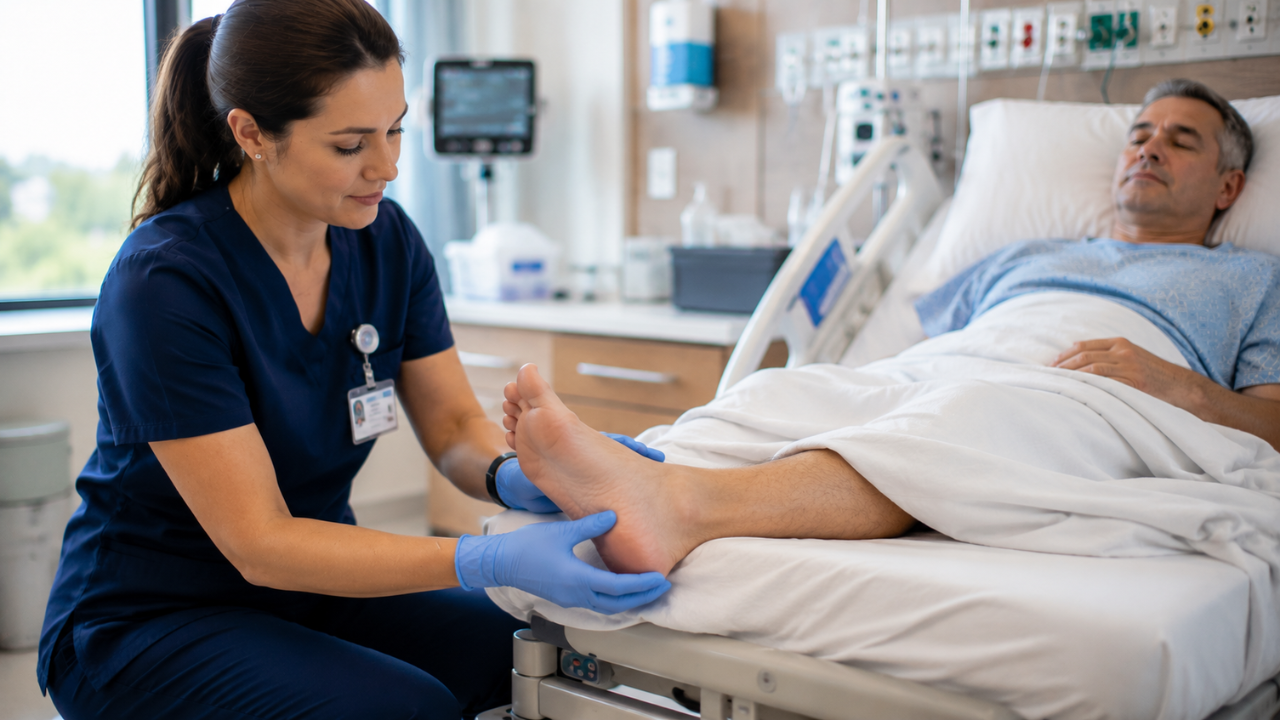
The diagnosis comes after the assessment. Work through this before you commit:
- Head-to-toe skin inspection, with special attention to bony prominences: sacrum, coccyx, ischium, greater trochanters, heels, elbows, occiput, and ears
- Wound characteristics: location, size (length by width by depth), wound bed, exudate amount and type, odor, periwound skin, and any tunneling or undermining
- Pressure injury staging: stage 1, 2, 3, 4, unstageable, and deep tissue pressure injury, and the rule that you do not reverse-stage a healing injury
- Risk scoring: the Braden subscales (sensory perception, moisture, activity, mobility, nutrition, friction and shear); the Norton Scale is an alternative
- Moisture and continence, so you can tell a pressure injury apart from moisture-associated skin damage (also called incontinence-associated dermatitis)
- Mobility and the patient’s ability to reposition independently
- Perfusion and sensation: pulses, capillary refill, edema, neuropathy in diabetic feet, and skin temperature and color
- Nutrition and hydration: weight change, intake, protein status, and albumin or prealbumin where available
- Labs and comorbidities: glucose and A1C, diabetes, peripheral vascular disease, immunosuppression, and relevant cultures
- Devices and adhesives, which cause medical adhesive-related skin injury and device-related pressure injuries
A few cue clusters that resolve quickly:
- Non-blanchable erythema over the sacrum plus immobility plus a Braden Scale of 12 points to a stage 1 pressure injury and impaired skin integrity.
- Perineal redness plus incontinence plus denuded skin in the folds points to moisture-associated skin damage, not a pressure injury.
- A full-thickness wound plus slough plus exposed subcutaneous tissue points to impaired tissue integrity, and you also assess for infection.
How to Choose the Right Skin Nursing Diagnosis
Run this from the top:
- Is the skin broken? If no and risk factors are present, choose risk for impaired skin integrity. If yes, continue.
- How deep is it? Damage to the epidermis and dermis means impaired skin integrity. Damage to deeper structures, such as muscle, means impaired tissue integrity.
- Signs of infection? Add risk for infection, or document an actual infection and notify the provider.
- Pain? Add acute pain or impaired comfort.
- Is the cause vascular? Consider ineffective peripheral tissue perfusion.
- Is immobility or poor nutrition driving it? Add impaired physical mobility and/or imbalanced nutrition.
Note: A patient often has several of these at once. The plan prioritizes the most urgent problem first, which usually means infection, perfusion, or deep tissue damage.
Priority and Related Nursing Diagnoses
These are chosen from the assessment, not assigned by default. Each one below tells you when it fits and the mistake to avoid.
Impaired Skin Integrity (Actual)
The star diagnosis. Use it when the epidermis or dermis is already disrupted: a stage 1 or 2 pressure injury, a skin tear, a surgical incision, or a superficial wound. Sample PES statement: “Impaired skin integrity related to prolonged pressure and immobility as evidenced by a stage 2 pressure injury to the sacrum with partial-thickness skin loss.” Common mistake: using it for a stage 3 or 4 wound that is really impaired tissue integrity.
Risk for Impaired Skin Integrity
Use it when the skin is intact but risk factors exist: immobility, moisture or incontinence, poor nutrition, a low Braden score, friction and shear, or devices. No defining characteristics and no “as evidenced by.” This is where the prevention bundle lives. Mistake: adding an AEB, or using it after the skin has already broken.
Impaired Tissue Integrity
Use it when damage extends below the dermis: a stage 3 or 4 or unstageable pressure injury, a full-thickness or deep ulcer, or a serious burn. Mistake: under-calling a deep wound as impaired skin integrity.
Risk for Adult Pressure Injury
Used for adults aged 18 and older; children and neonates fall under a separate nursing diagnosis. Use the current NANDA-I wording; older textbooks say “risk for pressure ulcer.” Drive it with the Braden Scale and a prevention bundle: repositioning, support surfaces, and moisture and nutrition management.
Risk for Infection
Broken skin is a portal of entry and a major risk factor for infection. Assess for the risk factors that make an infection more likely, such as chronic disease, invasive procedures, broken skin, and malnutrition. Watch for increasing redness, warmth, purulent or odorous drainage, fever, and an elevated white blood cell count. Keep this high in priority whenever the skin barrier is open.
Acute Pain or Impaired Comfort
Use it when wound pain or dressing changes cause distress. Pre-medicate before dressing changes and choose atraumatic dressings; pain affects healing, sleep, and the patient’s willingness to participate in care.
Ineffective Peripheral Tissue Perfusion
Use it when the cause is vascular (arterial, venous, or diabetic). Tie it to perfusion findings (pulses, color, temperature, edema) rather than the older generic “ineffective tissue perfusion.”
Imbalanced Nutrition: Less Than Body Requirements
Often the missing piece. Protein, calorie, vitamin C, and zinc deficits impair healing. Connect nutrition directly to wound repair and prevention.
Impaired Physical Mobility
Frequently the root cause of a pressure injury. Addressing mobility is a preventive intervention, not just a separate problem.
Readiness for Enhanced Health Management
Include one health-promotion diagnosis for a motivated patient or caregiver learning wound or ostomy care. It rounds out the taxonomy and shows these diagnoses are not only for problems.
Note: This is a partial list of diagnoses related to skin integrity. Always check with your clinical instructor to confirm which NANDA version your nursing program expects you to use.
How to Prioritize Skin Nursing Diagnoses
Use ABCs, safety, perfusion, and Maslow:
- First: signs of systemic infection or sepsis, compromised perfusion, and deep or necrotic wounds.
- Second: actual skin breakdown with a high infection risk.
- Third: pain and mobility problems that affect function and participation in care.
- Fourth: prevention, nutrition, education, and self-care for long-term healing.
This is the Next Generation NCLEX clinical-judgment cycle: recognize cues, analyze and prioritize, take action, and evaluate. Deciding what matters first is exactly the skill it rewards, and the worked scenario below puts the cycle into practice.
A Worked Patient Scenario
A 78-year-old patient recovering from a stroke has left-sided weakness, is incontinent of urine, has a low BMI, and a Braden score of 12. On your skin check you find non-blanchable redness over the sacrum and heels that are intact but clearly at risk.
Walk it through. The sacral finding is already an altered skin response, a stage 1 pressure injury, while the heels are still intact. The risk factors (age, left-sided weakness, incontinence, low BMI, and a Braden score of 12) strongly support several diagnoses, such as risk for infection.
Still, the non-blanchable redness over the sacrum makes the priority diagnosis impaired skin integrity. The second most important nursing diagnosis is impaired physical mobility, which drives most of the risk factors. The heels are still intact with strong risk factors, so they are risk for impaired skin integrity.
A sample SMART goal: the sacral and heel pressure injuries will demonstrate signs of reversal within 72 hours, evidenced by a reduction in non-blanchable skin, a reduced Braden Scale through improved incontinence management, and no new skin breakdown. Interventions: a repositioning schedule of every 2 hours, heel offloading, moisture and continence management, nutrition support, and documentation with measurement and photos. Evaluate against the skin reassessment and the Braden trend.
Sample Impaired Skin Integrity Nursing Care Plan Table
This is a helpful guide, but complete the care plan according to your school’s instructions.
| Nursing diagnosis | Supporting cues | Short-term goal | Long-term goal | Key interventions | Evaluation |
|---|---|---|---|---|---|
| Impaired skin integrity (pressure injury) | Stage 2 sacral injury, partial-thickness loss | No further breakdown in 72 hours | Wound heals without infection | Wound care, offloading, moist wound dressing | Wound bed and size trend |
| Risk for impaired skin integrity | Intact heels, Braden 12, immobility | Heels remain intact this shift | No new breakdown during stay | Prevention bundle, heel offload | Skin stays intact |
| Impaired tissue integrity | Full-thickness ulcer, exposed tissue | Wound bed shows granulation | Wound closes by secondary intention | Moist wound healing, debridement as ordered | Depth and tissue improve |
| Risk for infection | Open wound, elevated WBC, impaired mobility | No local signs of infection at the wound site | Wound heals; risk factors reduced (e.g., improved mobility) | Aseptic technique, monitor cues | No infection develops |
| Acute pain | 7/10 during dressing changes | Pain under 4/10 during care | Comfortable between dressing changes | Pre-medicate, atraumatic dressing | Patient reports lower pain |
Nursing Interventions for Impaired Skin Integrity

Group interventions by purpose, and give the reason for each.
Skin assessment and risk screening. Inspect head to toe, score the Braden each shift or per policy, document accurately with measurement and photos, and reassess whenever the patient’s condition changes.
Pressure redistribution and repositioning. Reposition on a schedule (commonly every two hours, adjusted for the support surface), use 30-degree lateral positioning, float and offload heels, use support surfaces such as a low-air-loss mattress, and keep the head of bed at or below 30 degrees to limit shear. Important: do not massage reddened bony prominences; massage is contraindicated and can worsen tissue damage.
Moisture and continence management. Apply barrier creams, cleanse promptly after incontinence, keep skin clean and dry, use appropriate absorbent products, and keep distinguishing moisture-associated damage from a pressure injury.
Wound care and dressing selection. Cleanse appropriately, apply moist wound healing, match the dressing to the wound (hydrocolloid, foam, alginate, hydrogel), know the debridement options, maintain aseptic technique, monitor for infection, and never reverse-stage a healing pressure injury.
Nutrition and hydration for healing. Promote adequate protein, calories, vitamin C, zinc, and fluids; involve a dietitian; and correct the deficits that delay healing.
Device and adhesive safety. Prevent medical adhesive-related skin injury with skin prep and gentle or silicone removal, and prevent device-related pressure injuries by repositioning tubing and cushioning under devices.
Education, self-care, and discharge. Teach the patient or caregiver daily skin checks, repositioning, nutrition, the signs of infection, and wound or ostomy care; arrange follow-up; and confirm understanding with teach-back.
Patient Education Points
- Inspect the skin daily, especially over bony areas and, for diabetics, the feet.
- Reposition or shift your weight regularly; do not stay in one position for long.
- Keep skin clean, dry, and moisturized, and manage incontinence promptly.
- Eat enough protein and drink enough fluids to support healing.
- Protect the feet with proper footwear, especially with diabetes or neuropathy.
- Do not pop blisters; protect skin tears and fragile skin.
- Use pressure-relief devices and dressings correctly.
- Report spreading redness, warmth, drainage, odor, fever, or increasing pain.
- Keep wound-clinic and follow-up appointments.
Common Mistakes Nursing Students Make
- Confusing risk for impaired skin integrity with actual impaired skin integrity.
- Adding “as evidenced by” to a risk diagnosis; risk diagnoses use risk factors only.
- Confusing impaired skin integrity (superficial) with impaired tissue integrity (deep).
- Labeling a stage 3 or 4 pressure injury as “impaired skin integrity.”
- Confusing a pressure injury with moisture-associated skin damage.
- Reverse-staging a healing pressure injury.
- Massaging reddened bony prominences.
- Writing a vague goal like “skin will be intact.”
- Writing interventions without rationales.
- Ignoring nutrition and the Braden assessment.
- Using outdated wording such as “decubitus ulcer” without checking current NANDA-I and NPIAP terms.
- Forgetting the deep tissue pressure injury and unstageable categories.
Example PES Statements
Examples only. Every statement has to match your own patient’s assessment data.
- Impaired skin integrity related to prolonged pressure and immobility as evidenced by a stage 2 pressure injury to the sacrum with partial-thickness skin loss.
- Risk for impaired skin integrity related to immobility, incontinence, and a Braden score of 12 (risk diagnosis: no “as evidenced by”).
- Impaired tissue integrity related to arterial insufficiency as evidenced by a full-thickness ulcer to the lateral lower leg with exposed subcutaneous tissue.
- Risk for infection related to disruption of the skin barrier and a full-thickness wound (risk diagnosis: risk factors only).
- Acute pain related to the wound and dressing changes as evidenced by the patient reporting 7/10 pain and guarding during care.
- Imbalanced nutrition: less than body requirements related to inadequate protein intake as evidenced by low prealbumin, weight loss, and delayed wound healing.
Free Impaired Skin Integrity Care Plan Worksheet
You can run the full decision path on a real patient with our skin integrity care plan worksheet, which takes you from the Braden score to actual-versus-risk to a measurable goal.
Key Takeaways
- Impaired skin integrity is a nursing diagnosis, not the medical cause.
- Decide actual versus risk first; a risk diagnosis never uses “as evidenced by.”
- Skin integrity is epidermis and dermis; tissue integrity is deeper structures.
- Base the diagnosis on your assessment and the Braden score, not on the presence of a wound alone.
- Prioritize perfusion and infection before routine prevention teaching.
- Strong care plans use measurable goals, interventions with rationales, and evaluation, and you do not reverse-stage a pressure injury.
The fastest way to make this reasoning automatic is to practice it under exam conditions. Our NCLEX-RN practice tests give you realistic practice so actual-versus-risk and skin-versus-tissue stop being a guess.