Nursing Diagnoses for Hypertension: A Guide for Students and New Grads
If you are building a care plan for a patient with high blood pressure, the medical diagnosis is the easy part. The hard part is the next step: deciding which nursing diagnosis actually fits this patient. Hypertension can sit behind a dozen different patient responses, and the right diagnosis depends on what your assessment shows, not on the blood pressure number alone.
Keep one distinction front and center. Hypertension is the medical diagnosis. A nursing diagnosis describes the patient’s response to that condition, or the risk it creates. Two patients can both have a reading of 168/96 and need completely different care plans. This guide walks you through how to tell them apart, how to write a defensible PES statement, and how to prioritize when a patient has more than one diagnosis at once.
Hypertension nursing diagnoses: a hybrid NANDA and Clinical Judgment Model guide. Hypertension is one of the most common chronic conditions nurses manage, so knowing how to care for this patient is essential. Modern nursing requires two things:
- NANDA nursing diagnoses for clinical paperwork and school assignments
- NCSBN’s Clinical Judgment Measurement Model (CJMM) for the Next Generation NCLEX and real practice
This hybrid guide shows you how to use both correctly.
Bottom line: Hypertension is the medical diagnosis, not the nursing diagnosis. Build the nursing diagnosis from your assessment cues, prioritize emergency symptoms, safety, and perfusion before education, and use NANDA labels when your assessment supports them. CJMM reasoning plus NANDA structure is a care plan that works in school and in practice. Do not reach for decreased cardiac output or excess fluid volume unless your findings actually support them.
In This Article:
- What hypertension means in a care plan
- Nursing diagnosis vs. medical diagnosis
- NANDA vs. CJMM
- Assessment data to collect first
- How to cluster cues and choose the right diagnosis
- Priority nursing diagnoses for hypertension
- How to prioritize (CJMM step 3)
- A worked patient scenario (NANDA and CJMM side by side)
- Sample hybrid care plan table and interventions
- Patient education and common mistakes
- Example PES statements plus CJMM reasoning statements
What Hypertension Means in a Care Plan
Hypertension is sustained high pressure against the arterial walls. Over time, it forces the heart to work harder against increased afterload and damages the vessels, kidneys, brain, and eyes. When developing your care plan, remember that the danger of hypertension is that it is usually silent. The patient often feels fine, which is exactly why so many nursing diagnoses for this population center on knowledge, management, and risk rather than acute symptoms.
A single reading does not make the diagnosis. The medical diagnosis of hypertension is an elevated blood pressure reading taken on two or more occasions. Blood pressure rises with pain, stress, a full bladder, recent caffeine or nicotine, a cuff that is too small, or an unsupported arm. Confirm the technique and the trend before you build anything on one number.
| Category | Systolic (mm Hg) | Diastolic (mm Hg) |
|---|---|---|
| Normal | Less than 120 | and less than 80 |
| Elevated | 120 to 129 | and less than 80 |
| Stage 1 hypertension | 130 to 139 | or 80 to 89 |
| Stage 2 hypertension | 140 or higher | or 90 or higher |
| Hypertensive crisis | Higher than 180 | and/or higher than 120 |
Important: A severely elevated reading with chest pain, shortness of breath, neurologic weakness, vision changes, confusion, or difficulty speaking is not a teaching moment. Treat it as urgent or emergent per your facility protocol and escalate.
Nursing Diagnosis vs. Medical Diagnosis
Hypertension is the medical diagnosis. The nursing diagnosis is your clinical judgment about how this specific patient is responding, or what they are at risk for. Depending on the patient data from your assessment, that might be decreased cardiac output, risk for unstable blood pressure, deficient knowledge, ineffective health management, excess fluid volume, decreased activity tolerance, acute pain, or readiness for enhanced health management.
The diagnosis comes from the data, never from the diagnosis label on the chart. Three quick examples show how the assessment data can change the nursing diagnosis:
- A patient who does not understand how to take a daily antihypertensive will need the deficient knowledge nursing diagnosis.
- A patient who understands the plan perfectly but skips doses because of cost may fit ineffective health management. The information is not the problem; the barrier is.
- A patient with ankle edema, crackles, and a sudden weight gain may have a plan of care focused on excess fluid volume.
Same blood pressure, three different care plans. That is the whole skill.
NANDA vs. CJMM
Why you need both
- NANDA nursing diagnoses for clinical paperwork and school assignments
- NCSBN’s Clinical Judgment Measurement Model (CJMM) for the Next Generation NCLEX and real practice
NANDA uses the nursing process steps, and CJMM uses clinical reasoning steps:
| NANDA: Nursing Process | NCSBN: CJMM |
|---|---|
| Assessment | Recognize Cues |
| Diagnosis / Analysis | Analyze Cues |
| Diagnosis / Analysis | Prioritize Hypotheses |
| Planning | Generate Solutions |
| Implementation | Take Action |
| Evaluation | Evaluate Outcomes |
While these models may look very similar, the thinking processes differ. For example, in the Assessment step of the nursing process, the nurse collects subjective and objective client data using a systematic approach. By contrast, the Recognize Cues skill of clinical judgment requires the nurse to collect client data and then decide what matters most. [WO: cite Elsevier, 2025.]
Assessment Data to Collect First
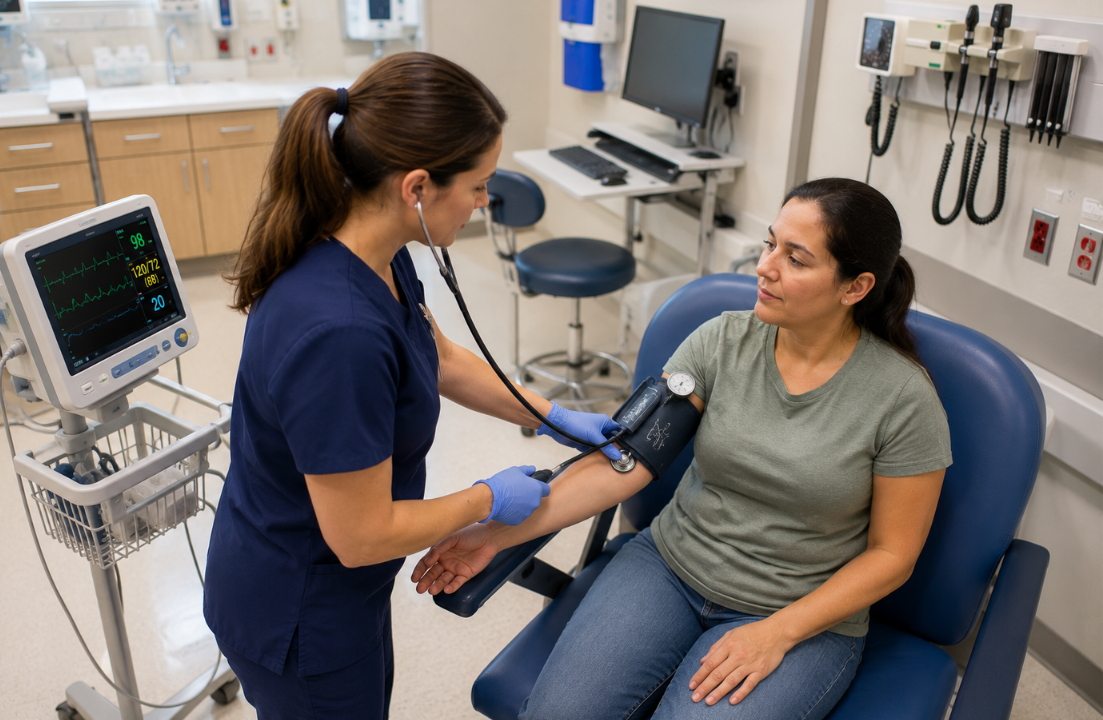
The nursing diagnosis comes after the assessment, not before. Using CJMM, recognizing the cues lets you build the care plan around what matters most. Work through this before you commit to a label:
- Blood pressure pattern and trend, plus correct cuff size, arm position, and technique
- Heart rate and rhythm, pulses, capillary refill, edema, and skin temperature
- Chest pain, dyspnea, fatigue, dizziness, headache, blurred vision, weakness, or neurologic changes
- Medication history: missed doses, side effects, over-the-counter products, and any barriers to adherence
- Lifestyle: sodium intake, alcohol, tobacco, activity, sleep, stress, and recent weight change
- Comorbidities: diabetes, chronic kidney disease, heart failure, pregnancy, stroke history, obesity, and sleep apnea
- Labs and tests you may review: creatinine, BUN, potassium, sodium, urinalysis, lipid panel, and ECG
Nurses do not determine a nursing diagnosis from a single finding. They group related cues first. A few clusters that point somewhere specific:
- High BP plus missed doses plus a knowledge gap points toward deficient knowledge or ineffective health management.
- High BP plus edema plus crackles plus weight gain points toward excess fluid volume.
- High BP plus dyspnea, fatigue, abnormal heart sounds, and poor activity tolerance may point toward decreased cardiac output.
How to Cluster Cues and Choose the Right Diagnosis
This is the step most articles skip. Use the cluster, then match it. The table below is a starting decision guide, not a substitute for clinical judgment.
| Cue cluster | Consider this nursing diagnosis |
|---|---|
| Fatigue, dyspnea, abnormal heart sounds, weak pulses, edema, poor perfusion | Decreased cardiac output |
| Missed medications, inconsistent home monitoring, fluctuating BP | Risk for unstable blood pressure |
| Incorrect beliefs about hypertension or medications | Deficient knowledge |
| Knows the plan but cannot follow it (cost, schedule, side effects, access, low support) | Ineffective health management |
| Edema, crackles, sudden weight gain, renal concerns | Excess fluid volume |
| Fatigue or an abnormal response to activity | Decreased activity tolerance |
| Headache or discomfort affecting function | Acute pain |
| Motivation to improve diet, activity, or BP tracking | Readiness for enhanced health management |
Note: The same patient often carries several of these at once. The care plan prioritizes the most urgent problem first, which the prioritization section below works through. Some of the related issues will resolve once you fix the primary concern.
In CJMM, analyzing the cues and determining the patient’s primary issues (hypotheses) leads to generating solutions and taking action.
Priority Nursing Diagnoses for Hypertension
Each diagnosis below follows the same pattern so you can quickly decide whether your assessment data supports it: when it fits, the cues that support it, a sample PES statement, and the student mistake to avoid.
Decreased Cardiac Output
Use this only when your assessment supports impaired pumping or an overworked heart, not for every hypertensive patient. Sustained high afterload makes the left ventricle work harder, and over time the heart can struggle to maintain output. Cues: dyspnea, fatigue, abnormal heart sounds, weak pulses, edema, cool extremities, decreased activity tolerance, and an altered heart rate. Sample PES statement: “Decreased cardiac output related to increased afterload as evidenced by dyspnea on exertion, fatigue, abnormal heart sounds, and elevated blood pressure.” Common mistake: choosing this diagnosis on a high number alone, with no cardiac findings to back it.
Risk for Unstable Blood Pressure
This one fits a huge share of real patients, because most are not in crisis but are at risk for losing control. Risk factors: inconsistent medication use, poor home monitoring, high sodium intake, stress, pain, medication side effects, substance use, and limited understanding of the plan. As a risk diagnosis, it uses risk factors only. There is no “as evidenced by,” because there are no signs and symptoms of actual instability yet. Interventions center on BP trending, home monitoring teaching, adherence support, follow-up planning, and teaching the patient when to escalate.
Deficient Knowledge
Use this when the patient lacks correct information about hypertension, the medication, diet, home monitoring, or follow-up. The signature is a statement that reveals a misunderstanding: “I only take my BP medicine when I feel bad,” or “I stopped the medication because my pressure got better.” Keep this distinct from ineffective health management. Deficient knowledge is not knowing. It is the wrong diagnosis when the patient knows the plan but cannot follow it.
Ineffective Health Management
This is an excellent diagnosis to use when the patient understands the plan but cannot carry it out in daily life: medication cost, transportation, a work schedule, side effects, low support, low health literacy, depression, a complex regimen, or limited food access. Assess the barrier before assuming the patient does not care. Interventions: simplify the routine, connect the patient to resources, use teach-back, address side effects, and coordinate follow-up.
Excess Fluid Volume
Use this only when findings support fluid retention, not as an automatic add-on. Cues: peripheral edema, crackles, sudden weight gain, dyspnea, jugular venous distention, reduced urine output, and a history of heart failure or renal failure. Interventions: daily weights, intake and output, lung and edema assessment, sodium teaching, and reporting worsening symptoms.
Decreased Activity Tolerance
Use the current NANDA-I wording, “decreased activity tolerance,” and note that older textbooks say “activity intolerance.” It fits when the patient has fatigue, dyspnea on exertion, weakness, dizziness, or an abnormal BP and heart-rate response to activity. Skip the generic “exercise more” advice. Focus on graded activity, monitoring the response, rest periods, and provider-approved planning.
Acute Pain
Use when pain is present and relevant to the plan, such as headache or chest discomfort that affects sleep, stress, or activity. Be careful: a headache does not automatically mean the high pressure caused it. Chest pain, neurologic symptoms, a severe headache, vision changes, or shortness of breath need prompt escalation per protocol.
Risk for Decreased Cardiac Tissue Perfusion or Risk for Ineffective Cerebral Tissue Perfusion
Use the region-specific perfusion diagnosis when signs or risk factors raise concern for a cardiac or neurologic complication: chest pain, a coronary artery disease history, diabetes, chronic kidney disease, severe elevation, stroke history, or abnormal ECG findings. This reinforces priority thinking; perfusion concerns come before routine education.
Readiness for Enhanced Health Management
Include one health-promotion diagnosis for the motivated patient who wants to improve BP control, medication routines, diet, activity, stress, or home monitoring. It is a useful reminder that nursing diagnoses are not only for problems.
How to Prioritize (CJMM Step 3)
When a patient carries several diagnoses, prioritize your hypotheses using ABCs, safety, perfusion, and Maslow:
- First: emergency signs and safety. Chest pain, stroke symptoms, severe BP with symptoms, respiratory distress, acute confusion, vision changes.
- Second: circulation, cardiac output, perfusion, and fluid volume. Decreased cardiac output, excess fluid volume, and perfusion-risk diagnoses.
- Third: symptoms affecting function. Pain, fatigue, decreased activity tolerance.
- Fourth: long-term control and prevention. Deficient knowledge, ineffective health management, and readiness for enhanced health management.
This is the Next Generation NCLEX clinical-judgment cycle: recognize cues, analyze and prioritize, take action, and evaluate. Deciding what matters first is exactly the skill it rewards, and the worked scenario below puts the cycle into practice.
A Worked Patient Scenario
A 58-year-old patient comes to the clinic with a BP of 168/96. They report missing medications about twice a week, have mild ankle edema, eat frequent processed foods, and say, “I feel fine, so I do not always take the pill.” They have type 2 diabetes and have never checked their BP at home.
Walk it through. The cues cluster into two stories: an adherence-and-management story (missed doses, “I feel fine,” no home monitoring, a real diabetes comorbidity) and a possible early fluid story (mild edema, processed-food sodium).
CJMM priority problem: uncontrolled hypertension related to inconsistent medication use and lack of home monitoring. The top NANDA candidates are ineffective health management, risk for unstable blood pressure, and deficient knowledge.
Because the patient describes a behavior gap rather than a knowledge gap (“I feel fine, so I do not take it”), ineffective health management leads, with risk for unstable blood pressure close behind. A sample SMART goal: the patient will take the prescribed antihypertensive every day and bring a completed home BP log to the next visit in two weeks. Interventions and priority actions: identify the specific barrier, simplify the regimen, teach home monitoring and the “treat the number, not the symptom” message, address the diabetes connection, and arrange follow-up. Evaluate against the log and the next set of readings.
Sample Hypertension Nursing Care Plan Table
This is a helpful guide, but complete the care plan according to your school’s instructions.
| Nursing diagnosis (NANDA) | CJMM framing | Supporting cues | Short-term goal | Long-term goal | Key interventions | Evaluation |
|---|---|---|---|---|---|---|
| Risk for unstable blood pressure | Risk for uncontrolled blood pressure | Missed doses, no home monitoring | BP within target range this visit | Sustained control with self-monitoring | Trend BP, teach home technique, adherence support | BP readings and log at follow-up |
| Deficient knowledge | Knowledge gap | “I take it only when I feel bad” | States why daily dosing matters | Manages medications independently | Teach-back, written plan, simple dosing schedule | Patient explains plan accurately |
| Ineffective health management | Behavior gap | Cost or schedule barriers, missed follow-up | Names one barrier and one solution | Follows the plan consistently | Simplify regimen, resources, follow-up | Doses taken, appointments kept |
| Decreased cardiac output | Perfusion issue | Dyspnea, fatigue, abnormal heart sounds | Reports easier breathing with activity | Stable cardiac output | Monitor perfusion, activity pacing, daily weights | Improved tolerance, stable vitals |
| Excess fluid volume | Fluid retention | Edema, crackles, weight gain | Loses excess fluid weight | Maintains dry weight | Daily weights, intake and output, sodium teaching | Edema and weight trend down |
| Decreased activity tolerance | Daily function issue | Fatigue, dyspnea on exertion | Completes ADLs with rest periods | Tolerates planned activity | Graded activity, monitor response | Meets activity goal safely |
Nursing Interventions for Hypertension
Group your interventions, or priority actions, by purpose instead of repeating them under each diagnosis, and give the reason each one matters.
Blood pressure monitoring and safety. Use correct technique, trend the readings rather than reacting to one, assess for symptoms, and escalate red flags. A single number is data; a trend is information.
Medication support. Support adherence, ask about side effects, review timing, surface the patient’s real concerns, and know when to notify the provider. Most “noncompliance” is a barrier in disguise.
Lifestyle and diet teaching. Cover sodium reduction, a heart-healthy pattern, alcohol limits, smoking cessation, weight management, and stress. Teach it as sustainable change, not a lecture.
Activity planning. Use gradual, provider-approved activity with rest periods, and monitor the response. Sudden exertion in a poorly controlled patient is a safety issue.
Fluid, renal, and cardiac monitoring. Watch edema, lung sounds, weight, urine output, labs, and any sign the condition is worsening.
Discharge teaching and follow-up. Build a home BP log habit, confirm the follow-up plan, review red flags and refills, and close with teach-back so you know the teaching landed.
Patient Education Points
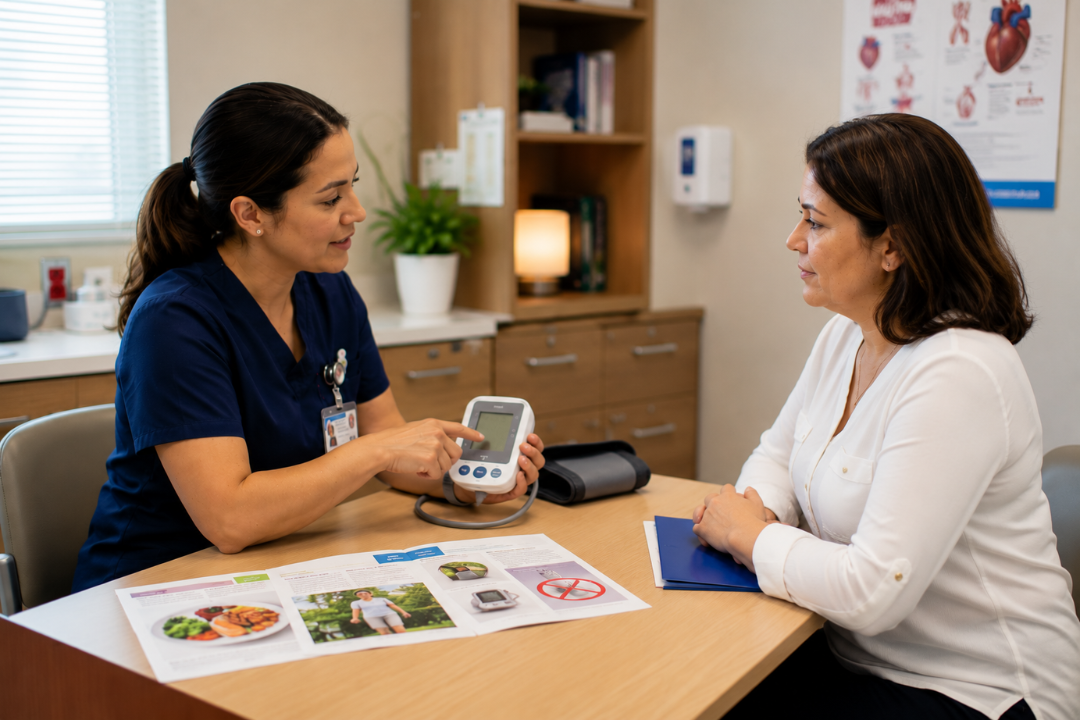
- Take your BP medications as prescribed, even when you feel well.
- Do not stop a medication without contacting your provider.
- Use correct home BP technique and keep a log to bring to appointments.
- Know your provider’s target BP goal.
- Limit sodium as instructed and follow activity guidance safely.
- Report side effects, and ask before using over-the-counter products that can affect BP or kidneys.
- Know the emergency symptoms: chest pain, shortness of breath, weakness, vision changes, severe headache, confusion, or difficulty speaking.
Common Mistakes Nursing Students Make
- Choosing decreased cardiac output just because the BP is high.
- Using deficient knowledge for every nonadherent patient instead of checking for a barrier.
- Forgetting to assess cost, access, side effects, and support.
- Writing a vague goal like “the patient will have normal BP.”
- Writing interventions without rationales.
- Listing provider orders as nursing interventions without explaining the nurse’s role.
- Failing to prioritize chest pain, neurologic symptoms, or shortness of breath.
- Not evaluating whether the teaching actually worked.
- Ignoring comorbidities such as diabetes, CKD, pregnancy, heart failure, or stroke history.
- Using outdated diagnosis wording without checking current NANDA-I terminology.
Example PES Statements
These are examples only. Every statement has to match your own patient’s assessment data.
- Decreased cardiac output related to increased afterload as evidenced by dyspnea on exertion, fatigue, abnormal heart sounds, and elevated blood pressure.
- Deficient knowledge related to new antihypertensive therapy as evidenced by the patient’s statement, “I only take my medication when I feel symptoms.”
- Ineffective health management related to medication cost and a complex regimen as evidenced by missed doses, uncontrolled readings, and missed follow-up appointments.
- Risk for unstable blood pressure related to inconsistent medication use, high sodium intake, and lack of home monitoring (risk diagnosis: risk factors only, no “as evidenced by”).
- Excess fluid volume related to compromised regulatory mechanism as evidenced by peripheral edema, sudden weight gain, crackles, and shortness of breath.
- Decreased activity tolerance related to an imbalance between oxygen supply and demand as evidenced by fatigue, dyspnea with activity, and an abnormal BP response to exertion.
CJMM Reasoning Example
- Cue cluster: missed medications, no home monitoring, diabetes
- Interpretation: risk for uncontrolled blood pressure
- Priority problem: inconsistent self-management
- Action: simplify the regimen, teach home monitoring, address barriers
Free Hypertension Nursing Care Plan Worksheet
You can practice the full reasoning chain with our hypertension care plan worksheet, which walks you from cues to a priority diagnosis to a measurable goal.
Key Takeaways
- Hypertension is the medical diagnosis, not the nursing diagnosis.
- Build the nursing diagnosis from assessment cues, never from the BP number alone.
- Prioritize emergency symptoms, perfusion, and safety before education.
- Do not use decreased cardiac output or excess fluid volume unless the assessment supports them.
- Deficient knowledge and ineffective health management are different diagnoses; the difference is knowing versus being able to follow the plan.
- A strong care plan uses measurable goals, interventions with rationales, and real evaluation, and pairs NANDA structure with CJMM reasoning.
If you want to think like a nurse under exam pressure, working practice questions is one of the most reliable ways to get there. Our NCLEX-RN practice tests give you realistic practice so the reasoning becomes second nature before test day.