
Healthcare is full of abbreviations: CNA, LPN, LVN, RN, MA, and more. If you’re just starting, this can be confusing. In this article, we will explain the roles of the Certified Nursing Assistant (CNA) and the Licensed Practical Nurse (LPN).
Here’s the simple version:
The main difference between a CNA and an LPN is the training level and scope of practice.
A CNA helps patients with basic daily care, such as bathing, dressing, eating, and mobility. Many CNA programs can be completed in about 4 to 12 weeks, depending on the school and schedule.
An LPN completes a longer practical nursing program, often around 12 to 18 months, and can do more medical tasks, such as giving medications, monitoring patients, and helping with wound care under supervision.
In this guide, we’ll break down CNA vs LPN duties, training, salary, job outlook, and which path may fit your goals best.
At a Glance: LPN vs. CNA Comparison
| Category | CNA | LPN |
| Full Title | Certified Nursing Assistant | Licensed Practical Nurse |
| Program Completion Time | 4-12 weeks on median | 12-18 months on median |
| Exam Required | Nursing Assistant Certification | NCLEX-PN |
| Median Salary | $42,260 per year | $62,340 per year |
| Primary Focus | Basic daily patient care | Basic nursing |
| Works under which providers | LPN, RN, MD, and other providers | RN, MD, and other providers |
| Best pathway | Quick entry into healthcare | Higher earning potential and advancement |
Salary data is from the U.S. Bureau of Labor Statistics, May 2025. Actual pay can vary by state, employer, shift, and experience. https://www.bls.gov/.
What Does a CNA Do?

A CNA helps patients with daily care. This role is very hands-on. CNAs often spend more time with patients than many other members of the care team.
CNAs are important because they help patients stay clean, safe, comfortable, and supported. They also watch for changes and report concerns to nurses.
Daily Patient Support Tasks
A CNA may help with:
- Bathing and grooming
- Getting dressed
- Toileting
- Feeding or serving meals
- Turning and repositioning patients
- Helping patients move from a bed to a wheelchair
- Making beds and changing linens
- Taking vital signs, such as blood pressure or temperature
- Listening to patient concerns
- Reporting changes to nurses
Where CNAs Usually Work
CNAs can work in many healthcare settings, but most often they work in:
- Nursing homes
- Skilled nursing facilities
- Hospitals
- Assisted living facilities
- Continuing care retirement communities
- Home healthcare
According to the BLS, the largest employers of nursing assistants are nursing care facilities and hospitals, followed by continuing care retirement communities and assisted living facilities for older adults.
What Does an LPN Do?
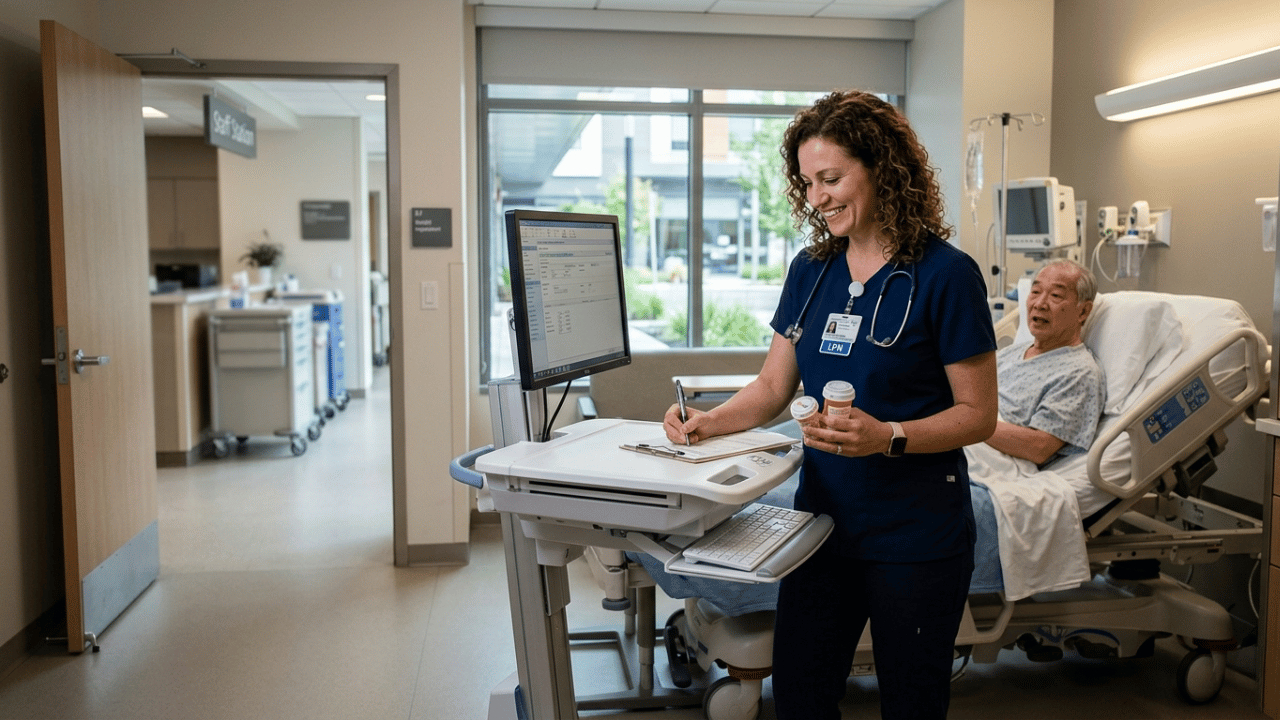
An LPN provides basic nursing care. This role goes beyond daily support tasks. LPNs are licensed nurses, which allows them to take on more clinical duties than CNAs.
LPNs still work closely with patients, but they also help carry out care plans, track patient health, and support RNs and doctors.
Clinical and Nursing Support Responsibilities
An LPN may:
- Monitor patient health
- Take and record vital signs
- Give medications, depending on state rules and workplace policy
- Help with wound care
- Change bandages
- Collect health information
- Update patient records
- Help with care plans
- Report patient changes to RNs or physicians
- Support patients and families with basic care instructions
Where LPNs Usually Work
LPNs often work in:
- Nursing homes
- Long-term care facilities
- Hospitals
- Clinics
- Physician offices
- Home health
- Residential care settings
LPNs work in many of the same facilities as CNAs, but their role includes more responsibilities.
LPN vs CNA: Main Differences
CNAs and LPNs both help patients. Both can work in busy care settings. Both roles matter.
But they are not the same job.
The biggest differences are training time, certification vs. licensure, scope of practice, and pay.
Training Length
CNA training is usually much shorter than LPN training. Many CNA programs can be completed in a few weeks, often around 4 to 12 weeks, depending on the program. The program includes classroom learning, lab practice, and clinical training.
LPN training takes longer because it is a formal nursing program. Many LPN programs take about 12 to 18 months and include classroom learning, lab practice, and clinical training with a more in-depth focus than the CNA.
Certification vs. Licensure
A CNA usually completes a state-approved nurse aide training program and passes a state certification exam. After that, they may be listed on their state’s nurse aide registry.
An LPN must complete a practical nursing program and pass the NCLEX-PN to become licensed. The NCLEX-PN is the national exam used for practical/vocational nurse licensure. The exam measures the nursing knowledge and clinical judgment needed for entry-level practical nurses.
Scope of Practice
Scope of practice means what you are legally allowed to do in your role.
CNAs focus on basic daily care. They help patients eat, bathe, dress, move, and stay comfortable. They also report changes to licensed nurses.
LPNs have a broader role. They can provide basic nursing care, give certain medications, perform some treatments, and have more patient care responsibilities. Exact duties can vary by state and employer.
Salary
LPNs earn more than CNAs because they have more training, more responsibility, and a nursing license.
According to the BLS:
- Nursing assistants: $42,260 median annual wage in May 2025
- LPNs/LVNs: $62,340 median annual wage in May 2025
That is a difference of about $22,810 per year based on national median wages.
Education and Training: CNA vs LPN
Training is one of the biggest things to compare when choosing between a CNA and an LPN.
If you want to start working quickly, becoming a CNA may be the better first step. If you can spend more time in school and want a nursing role, becoming an LPN may be worth it.
How Long Does It Take to Become a CNA?
CNA programs are usually short. Many can be finished in about 4 to 12 weeks, depending on whether you attend full-time, part-time, during the day, or in the evening.
CNA training includes:
- Classroom lessons
- Basic patient care skills
- Safety and infection control
- Hands-on practice
- Clinical experience in a care setting
After training, you will need to pass your state’s CNA exam before you can work as a certified nursing assistant.
How Long Does It Take to Become an LPN?
LPN programs are longer. Many take about 12 to 18 months, though the exact length depends on the school and program format.
LPN training includes:
- Anatomy and physiology
- Basic nursing skills
- Pharmacology
- Medical-surgical nursing
- Maternal and child health
- Mental health basics
- Clinical practice
After completing the program, you must pass the NCLEX-PN and apply for licensure through your state board of nursing.
Which Path Gets You into Healthcare Faster?
CNA is usually the faster route.
If your goal is to start working in healthcare as soon as possible, CNA training may help you get there faster and with less upfront schooling.
LPN takes longer, but it can lead to higher pay and more responsibility.
If you know you want to become a nurse and are ready for a longer program, becoming an LPN may be a stronger long-term move.
Job Duties: How Similar Are LPNs and CNAs?
CNAs and LPNs both work with patients. Both roles can be physically active, emotionally rewarding, and busy.
But they are not interchangeable. An LPN can do many things a CNA cannot because an LPN is licensed.
What Both Roles Have in Common
CNAs and LPNs both:
- Provide hands-on patient care
- Work as part of a healthcare team
- Spend a lot of time with patients
- Help patients stay safe and comfortable
- May work in long-term care or hospital settings
- Need strong communication skills
- Need patience, kindness, and attention to detail
Both jobs can also involve lifting, standing, walking, and helping patients move.
What Makes the LPN Role Different
The LPN role includes more clinical responsibility.
Compared to CNAs, LPNs may have:
- Licensed nursing duties
- More medication-related tasks
- More documentation
- More patient monitoring
- More responsibility for care plans
- A higher level of accountability
In simple terms, CNAs help with daily care. LPNs help with nursing care.
Which Role Has More Responsibility?
LPNs generally have more responsibility than CNAs.
That does not mean CNAs are less important. CNAs are often the people who notice small changes first because they spend so much time with patients.
But LPNs are licensed nurses. They have more training and a wider scope of practice. They may give medications, track patient conditions, support treatment plans, and report important updates to RNs or physicians.
So, if you want more medical tasks and more nursing responsibility, being an LPN may be the better fit.
Which Career Is Better for Beginners?
The better choice depends on your money, time, and goals.
There is no one “right” answer. Some people start as CNAs and love it. Others go straight into an LPN program because they already know they want to become a nurse.
Choose CNA if You Want to Start Working Faster
CNA may be a good fit if you want to:
- Start working in healthcare quickly
- Spend less time in school at first
- Get patient care experience
- See if nursing is right for you
- Earn money while planning your next step
- Build confidence before nursing school
CNA can be a smart first step if you are new to healthcare and want to learn what bedside care is really like.
Choose LPN if You Want a Broader Role
LPN may be a better fit if you want to:
- Become a licensed nurse
- Earn more than a CNA
- Take on more clinical tasks
- Have more responsibility
- Build a path toward becoming an RN later
- Spend more time in school now for better long-term options
LPN training takes longer, but it can give you a stronger nursing foundation.
Consider Cost, Time, and Goals
Before choosing, ask yourself:
- How fast do I need to start working?
- How much can I spend on school right now?
- Do I want basic care duties or nursing duties?
- Am I ready for a longer program?
- Do I want to become an RN someday?
- Would CNA experience help me feel more prepared?
If you need a quick start, CNA may make more sense. If you are ready to invest more time for higher pay and a nursing license, LPN may be the better choice.
Can You Go From CNA to LPN Later?
Yes. Many people start as CNAs and later become LPNs.
This can be a great path if you are not ready to commit to a full nursing program yet. Working as a CNA can help you learn patient care basics and decide if nursing is really for you.
Why Some People Start as a CNA First
Some people choose CNA first because it offers:
- Faster entry into healthcare
- Lower training time
- Early patient care experience
- Income while planning for school
- A better feel for healthcare work
- A chance to build confidence before becoming a nurse
CNA work can also look good on future nursing school applications because it shows that you have real patient care experience.
What the CNA-to-LPN Path Can Look Like
A CNA-to-LPN path may look like this:
- Complete a CNA training program
- Pass your state CNA exam
- Start working as a CNA
- Gain patient care experience
- Apply to an LPN program or CNA-to-LPN option
- Complete practical nursing training
- Pass the NCLEX-PN
- Apply for LPN licensure in your state
Some schools may offer bridge-style options, but rules and program formats vary. Always check with the school and your state board of nursing before enrolling.
Always tell your employer you want to advance to an LPN position. They often offer tuition reimbursement with an agreement to continue to work for them after you pass the NCLEX-PN.
Job Outlook for LPNs and CNAs
Both CNAs and LPNs are very sought after in healthcare, especially in long-term care, nursing homes, home health, and facilities that care for older adults.
The BLS projects about 211,800 openings for nursing assistants each year, on median, from 2024 to 2034.
For LPNs, the BLS projects about 54,400 openings each year, on median, during the same period.
Job demand can vary by state, city, employer, and type of facility. For example, a rural nursing home may have different staffing needs than a large city hospital.
Start Exploring Your Nursing Path
Choosing between CNA and LPN comes down to what you need right now and where you want to go next.
Here’s a quick final breakdown:
| Path | Pros | Cons |
| CNA | Fast training, lower barrier to entry, strong patient care experience, good first step into healthcare | Lower pay than LPN, fewer medical duties, physically demanding work |
| LPN | Higher pay, licensed nurse role, more clinical duties, stronger long-term nursing path | Longer training, higher school cost, more responsibility |
If you want the fastest way to start working with patients, CNA may be the right first step.
If you want to become a nurse sooner and take on more responsibility, LPN may be the better path.
Either way, both roles can help you build a future in healthcare.
Take the Next Step Toward Becoming a CNA or LPN
Practice with realistic CNA and NCLEX-PN exam questions, study tools, and healthcare exam prep resources from All Healthcare Careers.
References:
- U.S. Bureau of Labor Statistics. “Nursing Assistants and Orderlies.” Occupational Outlook Handbook and Occupational Employment and Wage Statistics, May 2025.
- U.S. Bureau of Labor Statistics. “Licensed Practical and Licensed Vocational Nurses.” Occupational Outlook Handbook and Occupational Employment and Wage Statistics, May 2025.
- PracticalNursing.org. “LPN Programs and Career Guide.”