
If you are a CNA thinking about your next move, you may have run into the term RNA and wondered whether it is a real step up or just another set of letters. Both a CNA and an RNA are nursing assistants, and both provide hands-on care. The difference is in what they are working toward. A Certified Nursing Assistant (CNA) keeps residents safe, comfortable, and stable day-to-day. A Restorative Nursing Assistant (RNA) helps residents regain abilities they have lost, such as walking, moving a stiff joint, or feeding themselves.
Think of the CNA role as the foundation and the RNA role as a specialization built on top of it. You cannot be an RNA without first being a CNA. For CNAs who feel they have plateaued in general care, the restorative path offers a different kind of reward. As an RNA, you will have the satisfaction of seeing measurable progress in the people you care for.
A note on the term “RNA.” In this article, RNA means Restorative Nursing Assistant, a CNA who has completed extra training in rehabilitation and restorative care. It is not the same as an RN (Registered Nurse), which is a licensed role that requires a nursing degree. RNA is also not a separate state-registered credential, unlike the CNA credential. It is a specialized CNA role awarded by completion of a restorative nursing assistant training program.
In This Article:
- The Certified Nursing Assistant (CNA)
- Key differences at a glance
- The Restorative Nursing Assistant (RNA)
- CNA vs. RNA, in depth
- Salary and career progression in 2026
- Choosing your next step
The Certified Nursing Assistant (CNA)

The CNA is the backbone of hands-on care. It is the most common entry point into healthcare, and the role residents and patients interact with the most during a shift.
A CNA’s day centers on activities of daily living (ADLs) plus basic monitoring. Typical responsibilities include:
- Taking and recording vital signs
- Helping residents bathe, dress, and groom
- Assisting with eating and tracking intake
- Helping residents move, transfer, and reposition safely
- Watching for changes in condition and reporting them to the nurse
CNAs work in nearly every care setting: long-term care facilities such as nursing homes and assisted living communities, hospitals, and home health. Wherever they work, the focus is the same. Keep the resident safe, clean, comfortable, and stable, and report anything that changes to the nurse.
Key Differences at a Glance
Before we go deeper into the restorative role, here is how the two compare side by side.
| Feature | Certified Nursing Assistant (CNA) | Restorative Nursing Assistant (RNA) |
|---|---|---|
| Core focus | Daily maintenance and safety | Rehabilitation and mobility |
| Prerequisite | High school diploma or GED | Current CNA certification |
| Education required | State-approved CNA training program | Current CNA credential and specialized restorative aide training program |
| Training length | 4-12 weeks | 8-60 hours additional coursework (typically 30 hours) |
| Cost | $200-$2000, some facilities will train for free with an agreement to work after certification. | $275-$1500 for online courses; many employers provide their own training with an agreement of continued employment |
| Daily tasks | Vital signs, feeding, bathing, hygiene | Range-of-motion exercises, gait and walking practice, and assistive device care |
| Works with | Nurses (LPNs and RNs) | Therapy team (PT and OT), under nursing supervision |
| Main goal | Comfort, safety, and monitoring | Independence and recovery |
| Salary | $42,260 a year (BLS.gov, May 2025) | CNA pay plus $1-3 dollars an hour, which is about $2,000-6,000 more a year |
| Career advancement | LPN/RN; MedTech; specialty aide roles, including RNA | Restorative nursing coordinator (RNPC), activity director, or LPN/RN |
| Best fit for | New to healthcare, seeking hands-on patient care | CNA who enjoys rehabilitation care and working with therapy teams |
The Restorative Nursing Assistant (RNA)

A Restorative Nursing Assistant is a CNA who has specialized in restorative care, which is the work of helping residents rebuild and keep the abilities they need to live as independently as possible. Where general care maintains a resident’s current condition, restorative care pushes gently toward improvement.
To become an RNA, you first earn and hold your CNA certification, then complete additional restorative training. This training runs somewhere in the range of 8-60 hours, though the exact amount depends on the employer or the program. The shorter range of hours, 8-12, is for experienced CNAs who have been working in rehabilitation centers for some time. The longer 60 hours is specific to facilities that require 30 hours of lecture and an additional 30 hours of hands-on experience. Most are in the middle, about 30 total hours for an online program.
Many facilities offer their own training with the agreement that you will continue to work for them. There are also online programs with a price range of $275-$1500. Some of the programs are for specific states, like Medstar, which is primarily for residents of Arizona.
Two nationally recognized programs are We Care Online Classes and the Critical Care Training Center. It is important to check with the facility you will work for to make sure they will accept the program training before you sign up.
Note: RNAs are not directly regulated by the state. However, when state inspectors evaluate a facility that offers rehabilitation and restorative services, they want to know that the RNAs have passed an acceptable course and are maintaining their CNA certification.
The day-to-day work looks different from general CNA care. Restorative tasks commonly include:
- Leading range-of-motion exercises that keep joints flexible and help prevent contractures
- Helping residents practice walking and gait training, often with a cane, walker, or gait belt
- Working with assistive and adaptive devices, including orthotics and prosthetics
- Running restorative dining programs that help residents feed themselves again
- Supporting bowel and bladder retraining programs
- Documenting each resident’s progress so the care team can track improvement
CNA vs. RNA, in Depth
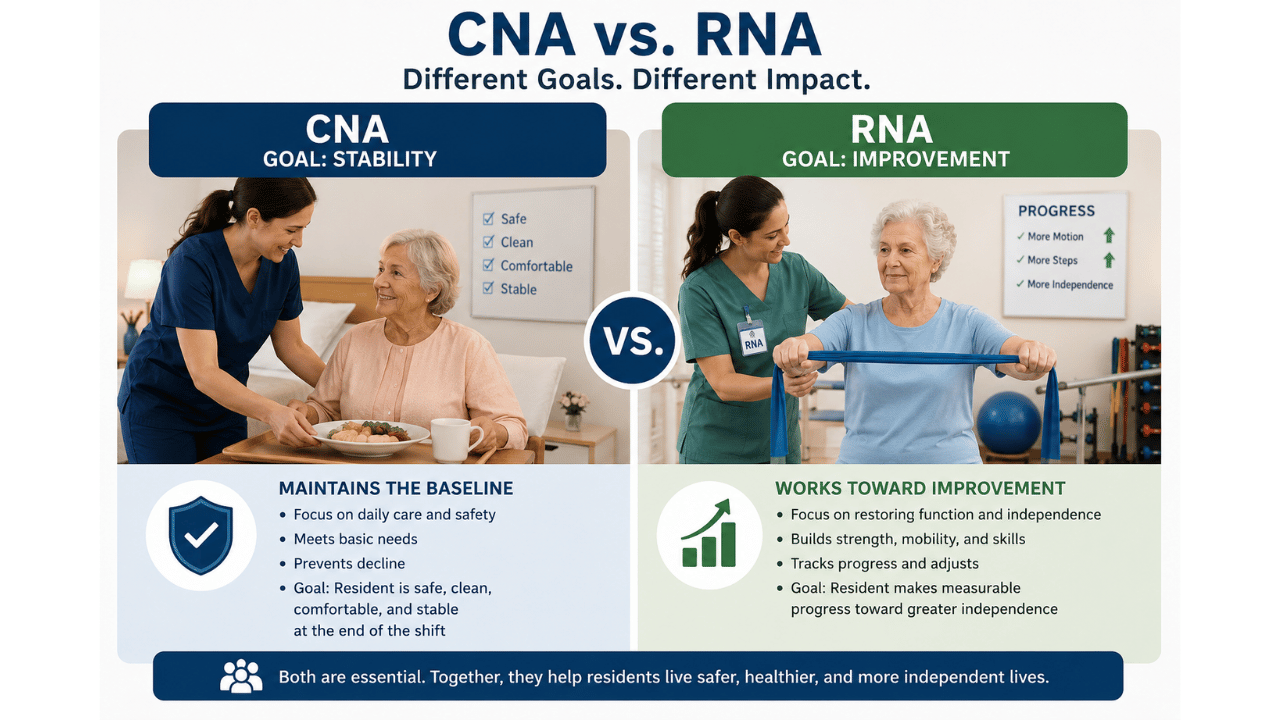
Maintenance versus progress. The clearest way to understand the difference is in the goal of the work. A CNA maintains a baseline: the resident is fed, clean, safe, and stable at the end of the shift. An RNA works toward a target. A few more degrees of motion in a stiff shoulder. A few more steps with a walker. One more meal eaten without help.
Who you work with. A CNA reports to the licensed nurse, usually an LPN or RN, who oversees the floor. The CNA receives their assignment and report from the nurse and directly reports any change in the resident to this nurse.
An RNA still works under nursing supervision, usually an RN who coordinates the Restorative Nursing Program (RNP). This coordinator is the RNA’s direct supervisor. Medical issues would be reported to the restorative coordinator, for example. The RNA also works with the physical and occupational therapists who create the exercise and feeding plans the resident needs, but they are not the RNA’s direct supervisor. The RNA carries it out and reports back on how the resident is progressing. The therapists can then update the resident’s plan as needed.
Physical demands. Both roles are physical, but in different ways. General CNA work involves a lot of repetitive lifting, turning, and transferring, often for many residents in a single shift. Restorative work is still hands-on, but it leans more on controlled, precise movement and technique, guiding one resident at a time through an exercise rather than working through a long task list. Good body mechanics matter in both roles; they are not optional.
Salary and Career Progression in 2026
Because an RNA is a specialized CNA, the base pay is similar, and the same market forces apply. The Bureau of Labor Statistics groups restorative aides together with all other nursing assistants, so there is no separate national salary figure for the RNA role. As of May 2025, the BLS reported a median wage of $42,260 a year for nursing assistants. ZipRecruiter’s May 2026 report says the average yearly salary for a CNA is between $32,000-$42,700.
What restorative training can add is a premium. Many skilled nursing facilities pay RNAs a slightly higher hourly rate, often around $1 to $3 more per hour, in recognition of the added skills. This averages out to about $2,000-$6,000 more a year. As of May 2026, ZipRecruiter reports the average salary for an RNA is between $34,150-$41,069 a year. Most facilities do not hire RNAs straight out; it is considered a second-tier CNA pay scale after working as a CNA. You will need to check with the facility and state work sites for a better idea of the pay range.
Note: A big advantage the CNA has over the RNA is the ability to work nights and weekends to earn overtime pay. RNAs work during the daytime hours only. Overtime can make a big difference in weekly pay.
The bigger value of the RNA role may be where it can lead. Spending your days on rehabilitation and mobility gives you real exposure to the kind of work physical and occupational therapists do. For CNAs who find they enjoy that side of care, the RNA role is a natural stepping stone toward training as a Physical Therapist Assistant (PTA) or Occupational Therapy Assistant (OTA). Those roles require their own associate-degree programs, so RNA experience does not replace that schooling. What it gives you is a clear, hands-on sense of whether that career is the right fit before you commit to it.
Choosing Your Next Step
So which path fits you? Here is a simple self-check.
Stay on the CNA path if:
- You like variety and a faster pace
- You are comfortable moving between many residents or patients in a shift
- You enjoy the broad, general nature of bedside care
Consider the RNA path if:
- You would rather work closely with a few residents on long-term goals
- You find satisfaction in seeing measurable progress over time
- You are curious about physical or occupational therapy as a longer-term direction
There is no wrong answer. The CNA role is essential and rewarding on its own, and not every CNA wants to specialize. But if your work has started to feel routine, restorative care is one of the most accessible ways to grow without leaving the bedside.
When you are ready to look into it, check your facility’s restorative nursing or therapy department for RNA training requirements. Many facilities encourage role advancement.
Before you specialize, it helps to be solid on the fundamentals that every nursing assistant is tested on. All Healthcare Careers offers practice tests that mirror the real CNA exam, so whether you stay in general care or move into restorative work, you can build from a strong foundation.