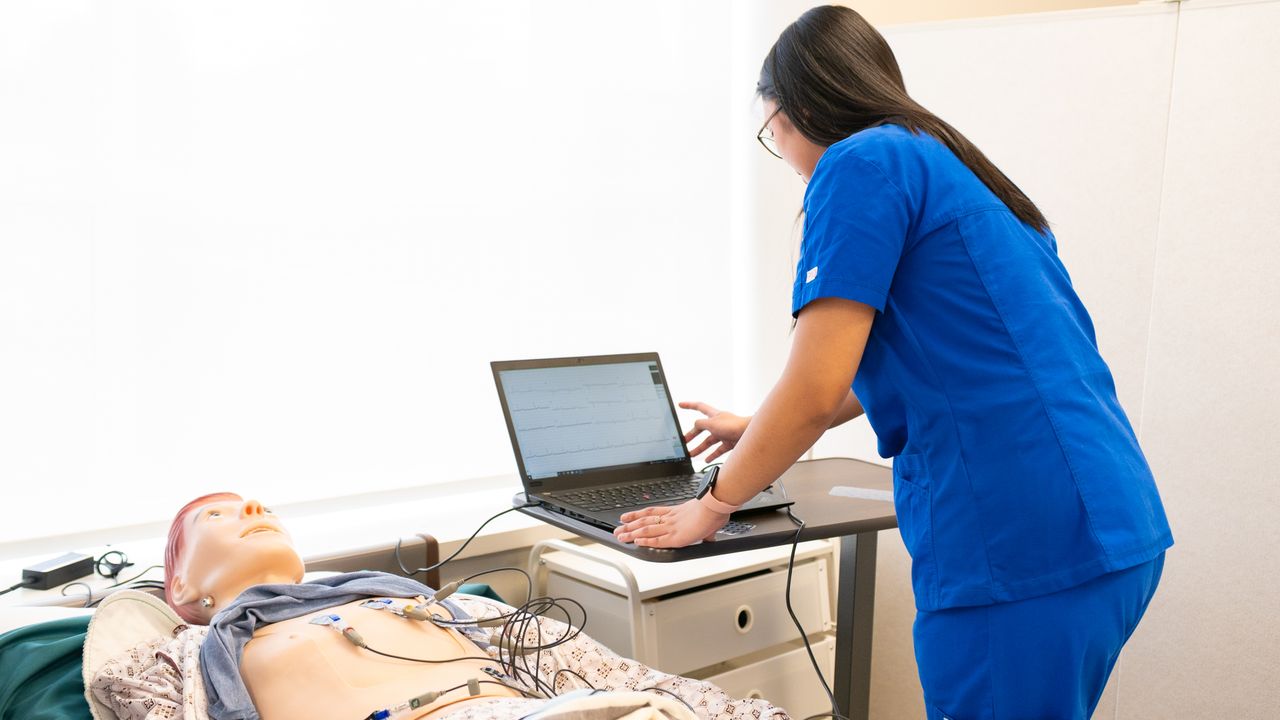

If a nursing program has just told you that you need to take the HESI A2, and you are not entirely sure what that is, you are in the right place. The exam is one of the two entrance tests that nursing schools in the United States use to decide acceptance into their program. It is not the only requirement, but it can decide whether you are even considered as an applicant.
Here is the short version. The HESI A2, short for the Health Education Systems Incorporated Admission Assessment, is a computer-based entrance exam published by Elsevier. It can include up to eight academic subjects, but almost no one takes all eight. Your school picks which sections you sit for, and most programs require four to six of them. Most schools want to see a score of 75 to 80 percent.
That last point is the one that trips people up, so it is worth saying again before we go any further: there is no single, universal HESI A2. The version you take is assembled by your school. This guide will walk you through all of it, what each section covers, how the scoring works, what counts as passing, and what happens if the first attempt does not go your way.
In This Article:
- What the HESI A2 is and who requires it
- Why your school picks your sections
- The eight academic sections
- The two parts that are not graded
- Length, question counts, and timing
- How scoring works
- What counts as a passing score
- How hard the exam really is
- Retakes and second attempts
- Scheduling and where you test
- How to prepare
What the HESI A2 Is and Who Requires It
The HESI A2 measures whether you have the academic foundation to survive a nursing curriculum. It is not a nursing exam. You are not tested on patient care, nursing theory, or anything clinical, because you have not learned it yet. What you are tested on is reading, math, grammar, vocabulary, and basic science, the tools you will need on day one of a nursing program.
Schools use it as an admissions filter, and many weigh it heavily. Nursing programs receive far more applications than they have seats, and a standardized entrance score gives an admissions committee a way to compare a student from one high school against a student from a community college two states away.
You will often see the HESI A2 required for associate degree nursing programs, bachelor of science in nursing programs, accelerated BSN programs, and practical nursing programs. Some allied health programs use it too.
Note: The HESI A2 is not the same thing as the HESI Exit Exam. The exit exam is taken near the end of a nursing program to predict how you will do on the NCLEX. Different exam, different purpose, different time in your life. If your school said HESI and you are applying, they mean the A2.
Why Your School Picks Your Sections
This is the single most useful thing to understand about this exam, and it is the thing most study guides bury.
Elsevier builds the HESI A2 as a menu. Your nursing program orders from it. One school might require Math, Reading Comprehension, Vocabulary, and Biology. Another might require Math, Reading, Grammar, and Anatomy and Physiology. A third might add Chemistry on top. The University of Arizona’s nursing program, to take one published example, requires exactly four sections and states plainly that Chemistry and Physiology scores are not counted even if you take them.
So before you buy a single study guide, before you build a study schedule, before you do anything else, go find out which sections your program requires. Call the admissions office if the website is unclear. Studying Physics for six weeks when your school does not score Physics is a genuine waste of your time, and it happens to people every application cycle.
Important: If you are applying to more than one program, check each one separately. You may need to sit for the union of all their required sections, and their passing thresholds may not match either.
The Eight Academic Sections
Elsevier has broken each section down to a set number of questions. They also add 5 pilot questions to every section. Pilot questions are ones Elsevier is testing to see how well they perform and whether they should become graded items. They do not count toward your score, and you will not be able to tell which ones they are.
The question breakdown is as follows:
| Section | Graded Questions | Focus |
|---|---|---|
| Mathematics | 50 (+5 pilot) | Arithmetic, fractions, ratios, percentages, conversions, dosage-style problems |
| Reading Comprehension | 47 (+5 pilot) | Main idea, inference, vocabulary in context, fact vs. opinion |
| Vocabulary and General Knowledge | 50 (+5 pilot) | Health and general vocabulary in context |
| Grammar | 50 (+5 pilot) | Parts of speech, agreement, punctuation, word choice |
| Biology | 25 (+5 pilot) | Cells, respiration, genetics, DNA and RNA |
| Chemistry | 25 (+5 pilot) | Atomic structure, bonding, reactions, solutions, acids and bases |
| Anatomy and Physiology | 25 (+5 pilot) | Body systems, terminology, directional terms |
| Physics | 25 (+5 pilot) | Motion, forces, energy, waves, basic electricity |
Here is what each subject actually covers.
Mathematics
This is the section most students worry about, and the good news is that the math is not advanced. There is no calculus, no trigonometry, and no algebra beyond solving basic equations. What you will see is arithmetic applied the way a nurse applies it: addition, subtraction, multiplication, and division; fractions and decimals; ratios and proportions; percentages; military time; and conversions between household, metric, and apothecary measurements.
Dosage-style word problems appear frequently, because that is what the math is for. If you can confidently convert 0.75 liters to milliliters, set up a proportion, and work with fractions without reaching for your phone, you are in reasonable shape.
The testing site provides an on-screen pop-up calculator, and that is the only calculator you are allowed to use. If it fails, the center will provide a manual one. Practice the arithmetic without a calculator anyway. Many math errors come from using the calculator incorrectly, so you want to be certain of your answers by double-checking your steps.
Reading Comprehension
You read short passages, often health-related, and answer questions about them. Finding the main idea. Identifying supporting details. Drawing a conclusion the passage supports. Distinguishing fact from opinion. Working out the meaning of a word from the sentence around it.
The passages are not difficult in themselves. The difficulty is pace. You are reading a lot of text under time pressure, and it is easy to start skimming and then miss the one qualifying word the question hinges on.
Vocabulary and General Knowledge
Roughly 50 words, many of them medical or health-related, tested for meaning in context. Think terms like “abstain,” “occluded,” “distended,” “flushed,” “labile.” Some are everyday words used in a clinical sense.
This is the most straightforwardly memorizable section on the exam. Flashcards work here in a way they do not work for reading comprehension.
Grammar
Parts of speech, subject-verb agreement, pronoun use, common misused word pairs, punctuation, and sentence structure. If you have not thought about the difference between “affect” and “effect” since high school, this is the section that will remind you.
Biology
Cell structure and function, cellular respiration, photosynthesis, mitosis and meiosis, DNA and RNA, basic genetics, and the classification of organisms. Introductory college biology, or a solid high school course, covers nearly all of it.
Chemistry
Atomic structure, the periodic table, chemical bonding, chemical equations and balancing, states of matter, solutions, acids and bases, and the basics of nuclear chemistry. This is a first-semester general chemistry survey.
Anatomy and Physiology
The body systems and how they work: skeletal, muscular, nervous, cardiovascular, respiratory, digestive, endocrine, urinary, reproductive, and integumentary. Anatomical terminology and directional terms show up here as well.
Many students find this the hardest science section, mostly because it is the broadest. There is simply more to know. You should not schedule your HESI A2 exam until you have completed the anatomy and physiology courses your nursing program requires. Having as much knowledge as possible before you test will improve your results.
Physics
The section fewest programs require. When it does appear, it covers motion, acceleration, projectile motion, friction, Newton’s laws, energy, waves, optics, and basic electricity. Check whether your school requires this one before you spend any time on it.
The Two Parts That Are Not Graded
Alongside the academic sections, most administrations include a Learning Style assessment and a Personality Profile. Together they run to roughly 30 questions.
Neither one is scored, and neither one can hurt your application. The Learning Style questions identify how you take in information best, and the results usually come with study suggestions matched to that style. The Personality Profile looks at traits that tend to affect how a person studies and works on a team.
Some students see these at the end of a long testing session and rush them. There is no penalty for that, but there is also no reason to. Answer them honestly. If your program offers academic support services, this is the data they may use to point you toward the right kind of help in your first semester.
Length, Question Counts, and Timing
Because your school selects the sections, there is no fixed total. A four-section exam is a very different afternoon from a six-section exam.
Run the numbers for your own version. Four science sections come to 100 graded questions. The four English and math sections come to 197. Most students land somewhere in between, and every section adds another 5 pilot questions on top. Add the two ungraded assessments and you are looking at another 30. A program requiring six or more academic sections can push the total past 300.
For time, many programs schedule a four-hour block for the whole sitting. Some testing centers time each section separately instead of giving you one overall clock. Your school or testing site will tell you which applies, and it is a fair question to ask when you register.
Tip: Whatever the format, the pacing problem is the same. Most students who run short on time do it in Reading Comprehension, because the passages invite re-reading. Decide in advance how long you will give a single question before you flag it and move on.
How Scoring Works
Each section is scored on its own, as a straight percentage of the questions you answered correctly. There is no curve and no scaled score to decode. If you get 41 out of 50 right, that section is an 82 percent.
Your school then does one of two things with those numbers. Some average all your required sections into a single composite score and hold that composite to one threshold. Others set a minimum for each individual section, which means a strong Reading score will not rescue a weak Math score. A few do both, requiring a composite minimum and a separate math minimum.
Good to know: There is no penalty for a wrong answer, so never leave a question blank. If you are down to the last minute of a section, answer everything.
What Counts as a Passing Score
Strictly speaking, the HESI A2 has no passing score. Elsevier does not set one. Your program does.
In practice, most nursing programs land somewhere between 75 and 80 percent, either as a composite or per section. Maricopa’s nursing programs, as one published example, require 75 percent or higher in Math and 80 percent or higher on the English composite of Reading, Vocabulary, and Grammar. The admissions information for your program, usually on its website, will give you the exact scores expected.
But treating the minimum as your target is a mistake, and this is where a lot of otherwise well-prepared applicants lose a seat. Competitive programs admit by rank, not by threshold. If a program has 40 seats and 300 qualified applicants, meeting the 75 percent minimum only puts you in the pool. It does not get you in. Aim well above the published minimum if the program you want is competitive, and find out whether they publish the average score of admitted students. Many do.
How Hard the Exam Really Is
Honestly? The content is not hard. The exam does not ask you anything you could not learn from a good high school or first-year college course.
What makes the HESI A2 difficult is breadth and staleness. You may be strong in biology and eight years removed from the last time you diagrammed a sentence. You may write beautifully and freeze at a ratio problem. The exam covers four or five genuinely different subjects in one sitting, and your weakest one drags on the average.
The second difficulty is stamina. Three to four hours of concentrated testing is tiring in a way that practicing one section at a time is not.
Students who struggle usually did one of three things: they studied only their strongest subject because it felt productive, they never practiced under realistic conditions, or they started studying two weeks out. Students who do well tend to give themselves four to six weeks, identify their weakest section early, and spend most of their time there.
Retakes and Second Attempts
If the first attempt does not go the way you wanted, you are not finished. Nearly every program allows a retake.
The rules come from your school, not from Elsevier, and they vary a good deal. A common pattern is two or three attempts within a 12-month period, with a mandatory waiting period of 30 to 60 days between them. Some schools count attempts per application cycle rather than per year. Some take your highest score across attempts, and others take the most recent one, which matters enormously if you are deciding whether to retake a score you can live with.
Scores also expire. One or two years from the test date is typical.
Important: Find out your program’s specific retake rule before you sit for the exam the first time, not after. Whether they use your best score or your latest score should change how you approach a second attempt.
Scheduling and Where You Test
Most students take the HESI A2 at the school they are applying to. Nursing programs commonly run their own testing sessions, and you register through the school’s testing center or admissions office. Some programs use a third-party proctoring service or allow a remote proctored sitting, and some let you test at another institution and send the score over.
You will need an Evolve account with Elsevier to access your results, and your school will give you the payment ID or access code that ties your exam to their program.
Cost typically runs somewhere between $35 and $100, and testing at a site other than your own school can add a proctoring fee on top of that. Seats fill up near application deadlines, so register earlier than feels necessary.
What to Bring on Test Day
When you schedule the exam, the testing center will tell you what to bring. Usually the minimum is one valid form of identification and proof of payment.
You are generally not allowed to bring anything else into the testing room. No cellphone. No food or drinks. No scrap paper and no pencil, because the center provides those. Centers do not make exceptions, and they will turn you away if you arrive without what they asked for.
Note: Rules do vary from one testing center to the next. Call yours if anything is unclear, and do it before test day rather than at the check-in desk.
How to Prepare
Start by finding out exactly which sections your program requires and what score it wants. Everything else follows from that.
Then take a full-length practice test before you study, not after. It feels backwards, and it is uncomfortable to score badly on purpose, but a cold baseline tells you in one afternoon where your real weak spots are. Almost everyone is surprised by at least one of them. Then spend your study time in proportion to what that test showed you, rather than in proportion to what you enjoy studying.
A Four-Week Sample Study Plan
This plan covers the four sections programs require most often. Adjust it to the sections your own school selected.
| Week | Reading Comprehension | Vocabulary and General Knowledge | Math | Anatomy and Physiology |
|---|---|---|---|---|
| Week 1 | Identify main idea and supporting details; practice inference questions; complete 2 to 3 short passages a day | Study 20 to 25 common HESI vocabulary terms; review prefixes and suffixes; general knowledge: basic science facts | Review fractions, decimals, percentages; practice order of operations; 15 to 20 problems a day | Review cell structure and tissues; introduction to the major body systems |
| Week 2 | Analyze author’s purpose and tone; practice multi-paragraph passages; timed practice in 10 to 12 minute sets | Add 30 new vocabulary terms; context-clue practice; general knowledge: basic U.S. history | Ratios, proportions, conversions; word problems | Deep dive: cardiovascular, respiratory, digestive; practice 15 to 20 A and P questions a day |
| Week 3 | Mixed passage sets, science and humanities; evaluate logical conclusions; 20 to 25 questions a day | Synonyms and antonyms practice; general knowledge: basic history of world events; daily 10 minute flashcard review | Multi-step problems; practice HESI-style ratio questions | Deep dive: endocrine, nervous, urinary; system interactions; practice scenario-based questions |
| Week 4: exam simulation | Full-length reading practice test | Final vocabulary set of 20 to 30 terms; mixed general knowledge quiz | Full-length math practice test; review all conversions and ratios | Full-length anatomy and physiology practice test |
Practice questions are what turn recognition into recall. Reading a chemistry chapter and nodding along is not the same skill as answering a chemistry question under time pressure with four plausible options in front of you. All Healthcare Careers provides full-length HESI A2 practice tests across all eight subjects, written and reviewed by nurse educators, so that the questions you see while studying look like the questions you will see on test day.
You have more control over this exam than it feels like right now. The content is learnable, the format is predictable, and the score is not a judgment on whether you will make a good nurse. It is one gate, and it is one you can prepare for.