

If you have looked into working as a CNA in more than one state, you have probably run into a frustrating surprise. There is no “multi-state CNA license.” Nurses have the Nurse Licensure Compact (NLC), which allows a registered nurse or LPN to hold a single multistate license and work across dozens of states. Nursing assistants have no equivalent. The compact does not cover CNAs.
Here is the good news, and it is bigger than it sounds: you do not need a compact. CNAs work across state lines through reciprocity, the process by which one state recognizes the certification you already earned in another. Reciprocity is usually straightforward, and once you understand the steps, holding certification in more than one state is very doable. This guide gives you the checklist.
A quick note on the word “license.” The CNA credential is technically a certification listed on a state Nurse Aide Registry rather than a license, as that term is used in nursing or medicine. Most people, employers, and state agencies still say “CNA license,” so this guide does too. The process is the same either way.
Bottom line: There is no CNA compact and no single multi-state license. You reach multiple states through reciprocity, applying one state at a time. Keep your primary certification active and in good standing, research each target state’s rules before you apply, expect a fresh background check in every state, and start at least 60 days before a move or travel contract.
In This Article:
- Verify your primary certification
- Research your target state’s rules
- The application process
- Maintaining multiple certifications
- The future of CNA licensing
Step 1: Verify Your Primary Certification
Before you apply anywhere new, run a registry verification on the certification you already hold. Everything else builds on it.

Visit your current state’s Nurse Aide Registry and confirm your status reads “Active.” A “lapsed” or “inactive” certification cannot be transferred or used as the basis for reciprocity. It has to be active and in good standing first.
Federal law also sets a work requirement that keeps your certification active. You must complete 12 hours of continuing education every year and have at least 8 hours of paid nursing-related work within every 24 months. This matters for multi-state work in particular: you cannot transfer your certification to another state, or keep working in one, if you let your primary certification lapse. If you have not worked enough recently, you may have to re-test rather than transfer.
Important: Reciprocity is built on your primary certification. Protect it. A lapse there can unravel certifications you hold elsewhere.
Step 2: Research Your Target State’s Rules
Each state sets its own reciprocity rules, so research the target state before you apply. Search for the state’s “Department of Health” or “Board of Nursing” to find the official Nurse Aide Registry. Avoid third-party sites that charge for information the state provides for free.
Prepare for a fee. Costs range widely from one state to the next. Many states will say there is no fee to be placed on the state registry, but there will be other fees, such as the application fee, a background check, and fingerprinting.
Not all reciprocity is equal. Some states offer “direct” reciprocity and accept your certification with simple paperwork. Others have “strict” reciprocity and may require extra steps, such as additional fingerprinting or proof that your original training met their hour requirement. This last point catches people off guard: federal law sets a floor of 75 training hours, but some states require more. If you trained in a 75-hour state and move to a state that requires more, you may be asked to make up the difference before the new state grants reciprocity. Many states will accept work experience in place of training hours, so it is important to keep good records of your work history.
Reciprocity registry fees (all require fingerprint background checks):
| State | Fee | Additional requirements / fees |
|---|---|---|
| Alaska | $275 | Must meet program-hour equivalent through testing |
| Arizona | $50 | |
| Colorado | $10 | |
| Connecticut | $55 | Processed through Prometric |
| Delaware | $30 | |
| District of Columbia | $15 | |
| Hawaii | $25 | Processed through Prometric |
| Illinois | $25 | |
| Indiana | $65 | |
| Kansas | $20 | |
| Louisiana | $35 | Processed through Prometric |
| Maryland | $20 | |
| Michigan | $20 | |
| Mississippi | $26 | Processed through Headmaster |
| Nevada | $50 | |
| New Hampshire | $82 | |
| New Jersey | $30 | |
| New York | $50 | Processed through Prometric |
| Oregon | $60 | |
| Rhode Island | $35 | |
| Tennessee | $20 | Processed through Headmaster |
| Utah | $30 | |
| Vermont | $20 | |
| Washington | $32 | Processed through Credentia |
| Wyoming | $120 | Additional testing, depending on the original certification program |
There is no application (registry) fee in the following states: Alabama, Arkansas, California, Florida, Georgia, Idaho, Iowa, Kentucky, Maine, Massachusetts, Minnesota, Missouri, Montana, Nebraska, New Mexico, North Carolina, North Dakota, Ohio, Oklahoma, Pennsylvania, South Carolina, South Dakota, Texas, Virginia, West Virginia, and Wisconsin.
Every state requires a fingerprint background check, which you have to pay for. On top of that, some states charge testing fees. Nebraska, for example, requires a $30 online abuse and child-neglect class. Check with the state registry or third-party vendor for the specific requirements.
Note: Fees and rules change as states update their registries and rebid testing contracts. Confirm the current requirement in the target state’s nurse aide candidate handbook before you rely on any figure.
Step 3: The Application Process
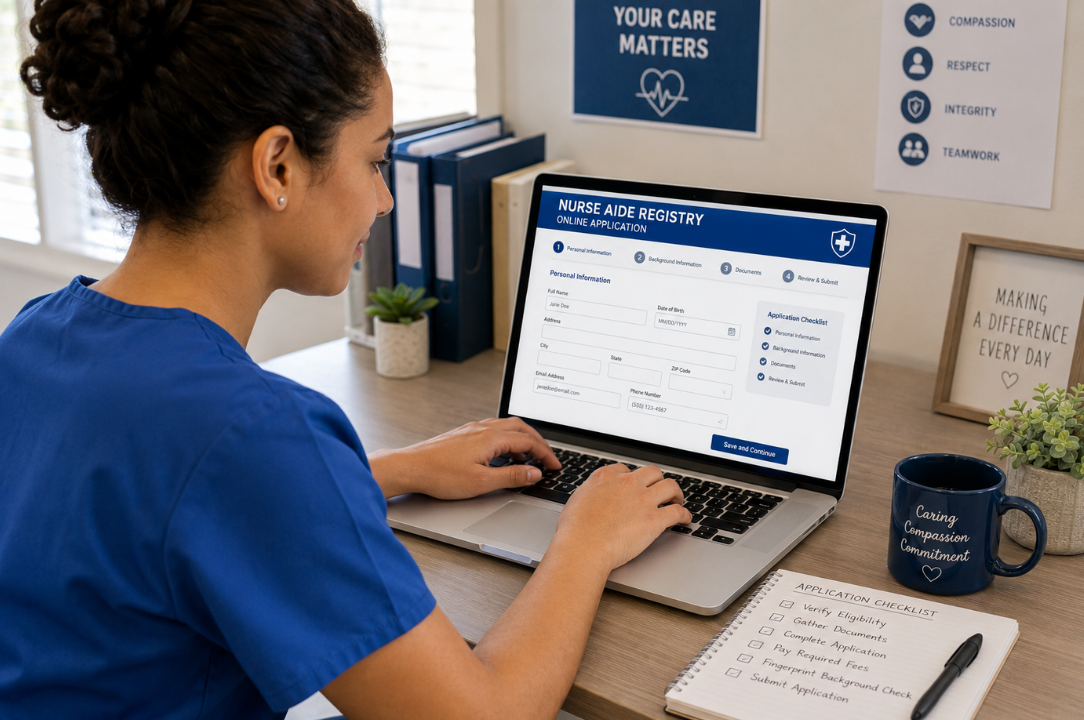
Once you know the target state’s rules, the application itself is about submitting the right paperwork. Here is what to have ready.
Identification. Standardize this set: your Social Security number, a government-issued photo ID, and proof of your initial training from a state-approved program.
Verification of certification. The new state has to confirm your certification with the state that issued it. Some states do this digitally; others require a paper interstate verification form completed by your original registry. This may be handled by the state registry or a third-party vendor such as Prometric or Credentia. Remember, it does not matter who verifies your certification; it is up to you to make sure it is completed.
Background check. You cannot reuse a background check from your home state. Each new state requires its own state and federal check, which means new fingerprints captured by LiveScan at a local facility. Budget time for this; results usually take at least one week.
Tip: Submit electronically whenever you can. An online application gives you a tracking number and a record, which matters when you are managing the process in more than one state at once.
Step 4: Maintaining Multiple Certifications

Earning certification in a second or third state is only half the job. Keeping all of them active is where people lose hard-won credentials. A little organization protects them.
- Track each expiration date separately. States renew on different cycles. One state may tie renewal to your birthday, another to the date your certification was issued. Write down each date as soon as you receive the certification, and use a calendar app that will send you a reminder when it is time to renew.
- Do not assume one state’s CEUs satisfy another’s. Continuing education or in-service hours you complete for one state may not count toward another state’s renewal. Check each state’s requirement.
- Update the registry when you move. Most states expect you to update your address and contact information with the registry promptly after a move. Many states allow 30 days to report a change, but again, double-check; the sooner the better is a good rule to follow. Falling out of contact can lead to administrative penalties or a missed renewal notice.
Tip: Keep a simple one-page document listing every state you are certified in, its expiration date, and its CEU requirement. When you hold certifications in multiple states, that document is the difference between renewing on time and scrambling. Several apps can help you stay organized.
The Future of CNA Licensing
There are good reasons to hold certification in more than one state, such as travel-CNA work or moving frequently because a family member is in the military. Multiple certifications can also widen your job options. Many companies want CNAs who can work across state lines to care for clients who live in nearby states.
It is reasonable to ask why nursing assistants do not have a compact when nurses do. The question is getting more attention as demand for CNAs grows and more aides take travel and multi-state work.
For now, no interstate compact for nursing assistants exists, and reciprocity remains the path. The main reason is that there is still too much variation in state requirements for the CNA. If a CNA compact were ever adopted, it would do for aides what the NLC does for nurses: replace the state-by-state reciprocity process with a single credential recognized across member states.
The best way to stay current on changes to CNA certification is to check your state registry regularly, where any news or updates about your certification will be posted.
Ready to Take Your Skills Across State Lines?
You do not need a compact to build a multi-state CNA career. You need a plan and a head start. The reciprocity path comes down to four moves:
- Confirm your primary certification is active and in good standing.
- Research the target state’s registry, fees, and reciprocity type.
- Submit your application with verification and a fresh background check.
- Track every certification’s expiration and CEU requirement separately.
Start at least 60 days before a planned move or travel contract, because background checks and verification forms take time you cannot rush. Visit your target state’s Nurse Aide Registry portal today and download the application so you are not waiting on paperwork when you are ready to work.
If you’re only relocating to one new state instead of building multiple certifications, see our guide on How to Transfer Your CNA License to Another State.
If a target state requires you to test again, practice questions are the most reliable way to prepare. All Healthcare Careers offers realistic CNA practice tests to help you pass on the first try.