
Reciprocity is the process by which one state recognizes a Certified Nursing Assistant certification that you earned somewhere else. If you are moving across state lines, this is the path that lets you keep working without having to start over. In most cases, you will not have to repeat your full training program or retake the certification exam. The move is an administrative hurdle, not a career reset.
One thing has to be true before anything else: your certification must be in good standing. Good standing means you are active, your required continuing education and work hours are current, and your record contains no findings of abuse, neglect, or misappropriation of property. If that is in place, the rest is paperwork. This guide walks you through it so you can transfer your certification and work in another state without any complications.
A quick note on the word “license.” The CNA credential is technically a certification listed on a state Nurse Aide Registry rather than a license, as that term is used in nursing or medicine. Most people, employers, and state agencies still say “CNA license“, so this guide does too.
Bottom line: There is no national CNA license and no interstate compact for nursing assistants. You transfer your certification one state at a time through reciprocity. If your goal is to hold certifications in multiple states or pursue travel CNA opportunities, see our guide on getting a multi-state CNA license.
In This Article:
- Verify your current status
- Research the new state’s registry
- Gather your documents
- Submit the application
- Timeline, costs, and what to expect
Step 1: Verify Your Current Status
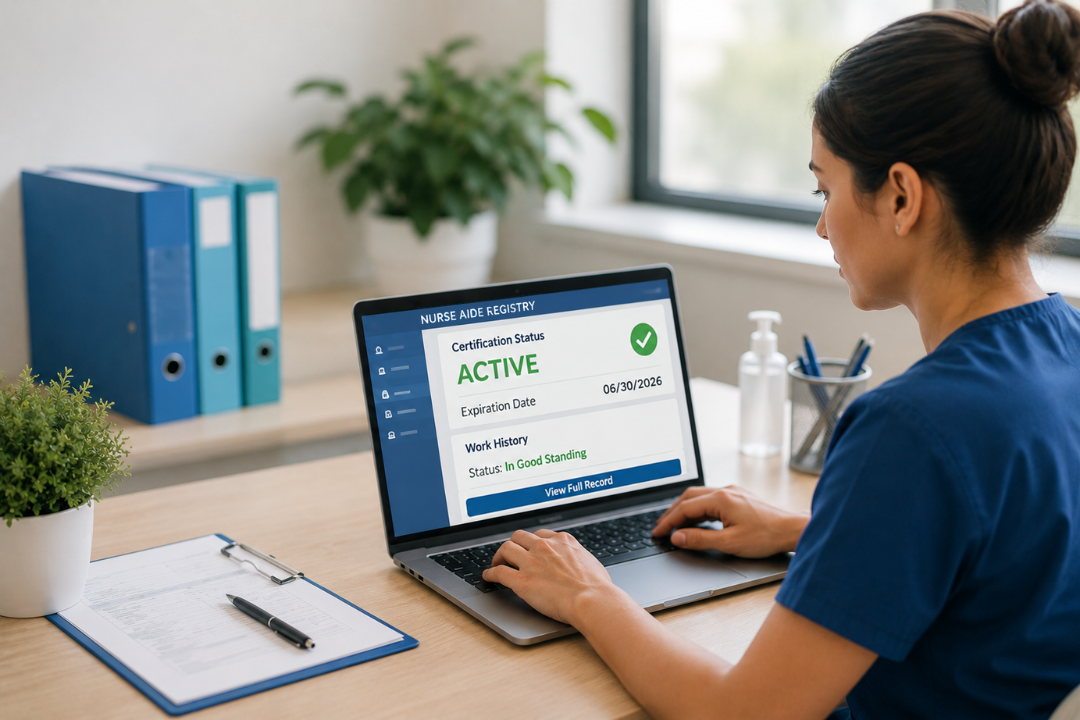
Before you apply anywhere, do a registry verification on the certification you already hold. Visit your current state’s Nurse Aide Registry website and confirm two things: your status and your work history.
Your status should read “Active.” If it reads “Expired,” “Lapsed,” or “Inactive,” you cannot transfer it through reciprocity. A lapsed certification is the same as saying you are no longer certified. The new state cannot verify your status and will require you to retest. Check this even if you are sure you are current; the due date for maintaining your certification can pass by quickly.
Federal law sets the work requirement that keeps your certification active. You must complete 12 hours of continuing education every year and have at least 8 hours of paid nursing-related work within every 24 months. If you have not worked recently, double-check that you have the required hours before you try to transfer to another state.
Important: A negative finding follows you. A substantiated finding of abuse, neglect, or misappropriation of a resident’s property is reported to the registry and will permanently block a transfer. There is no reciprocity around a finding like this.
Step 2: Research the New State’s Registry
Not every state handles reciprocity the same way. Find the new state’s Nurse Aide Registry, usually run through its Department of Health or Board of Nursing, and learn which pathway it falls into before you fill out a single form or pay a fee.
There are four common pathways to transferring your license to another state:
The Direct Pathway (Standard Endorsement): You can apply directly to the state registry to have your certification transferred. Be aware that many states will also require verification of work experience and a minimum number of hours.
The Indirect Employer-Driven Pathway: These states require you to have a job in the state before they will allow transfer of certification. The good news is that once you are hired, the employer does the work for you.
The Indirect Hour-Mismatch Pathway (Equivalency Gates): You can apply to these states directly, but be aware that they will filter your application against their education standards. Several states will take a solid work history as an equivalent to educational hours.
The Indirect Administrative Lockout (Historical Profiles): If you try to return to a state where you have already worked as a CNA, you cannot use the direct pathway. Your Social Security number will flag you as having worked in the state before. These states are California, Florida, Massachusetts, North Carolina, and Texas. Most of them require retesting. The catch: if you try to apply directly, you may simply be rejected without knowing why.

Most states use their own portal for the certification registry. It may be called the state registry, or it may be found on the state nursing board or the health department site. A quick internet search for your state will give you the correct website. Some states use a third-party vendor to manage certifications, new applications, and transfers.
States using third-party vendors (as of May 2026):
| Vendor | States |
|---|---|
| Prometric | Connecticut, Delaware, Hawaii, Louisiana, New York |
| Credentia | Alabama, North Carolina, Pennsylvania, South Carolina, Washington |
| Headmaster (D&S Diversified Technologies / TMU) | Mississippi, Montana, New Mexico, North Dakota, Ohio, Tennessee, Wisconsin |
Third-party vendors verify the information and send it to the state registry, but you still need to make sure you are meeting all the state requirements. Always look it up yourself so nothing is missed.
Note: Portal and vendor assignments change because states periodically rebid their testing and registry contracts. Always confirm the current portal in the new state’s nurse aide candidate handbook before you start.
Step 3: Gather Essential Documentation
Reciprocity moves faster when your documents are ready before you begin. Think of this as a digital folder you can upload from. Have the following scanned and on hand:
- Your current CNA certificate. A copy of the certificate or card from the state where you are certified.
- Proof of identity. Your Social Security card and a government-issued photo ID, such as a driver’s license or passport.
- Proof of training. Your high school diploma or your completion certificate from a state-approved nurse aide training program.
- Employment verification. Recent pay stubs or a signed letter from a current or recent supervisor, in case the new state requires proof of work.
Tip: Save these as clear PDF scans in one folder with simple file names. Most registry portals reject blurry phone photos, and a clean upload the first time saves you a round of follow-up requests.
Step 4: Submit the Application
Once your documents are ready, submit the application through the new state’s registry or to the vendor site. Apply electronically whenever the option exists. An online submission gives you a record and lets you track where your application stands; a mailed paper form does not.
Many states route reciprocity applications through a third-party vendor such as Credentia or Prometric rather than handling them in-house. Follow whichever path the new state’s registry directs you to.
Plan on a new background check. Federal law requires a background check with fingerprints, but each state can choose how it wants that completed. A background check from your home state does not carry over. The new state registry will have exact instructions for completing the fingerprint and background checks. Some use a LiveScan electronic scan at a local facility or police station. Others still allow physical fingerprints to be mailed in. Before you get a background check or fingerprints, make sure you follow the instructions, or it will not be accepted.

Important Considerations
A few practical realities to plan around.
Timeline. Reciprocity processing is not instant. Plan for several weeks from submission to approval. If you have completed everything correctly (the application, background check, and fingerprints) and paid the fees, it will take 2 to 8 weeks. The range gives the state registry enough time to verify all the information, and it can be affected by things like legal holidays when state offices are closed. Starting early is the single best thing you can do to avoid a gap in work.
Cost. Some states charge nothing for reciprocity; others charge a fee. Fees to apply range from $0 to $275. Many states do not charge a fee to apply for transfer, but there may be other costs, such as testing or fingerprint and background-check fees. Ask your new employer whether they reimburse reciprocity fees, because many healthcare employers do.
Working while you wait. Most states will not let you work until your certification appears on their registry. Alabama, Arkansas, and Montana require you to have a job before you can transfer to their state; they will let you work for 30 days while it is being processed. South Dakota allows 60 days. Idaho requires a job offer and will not let you work without state registry verification, but it has one of the quickest turnaround times, about 2 weeks.
Ready to Make Your Move? Start Your Application Today
The biggest risk in transferring your certification is waiting too long. The longer you delay, the higher the chance of a gap between your last shift in your old state and your first shift in the new one.
So start now. Verify your status, research the new state’s pathway, gather your folder, and submit. Once your new certification arrives, keep both a physical and a digital copy, and write down the new expiration date right away, because it may not match the renewal cycle you were on before.
If your certification has lapsed and your new state requires you to test again, practice questions are the most reliable way to walk in prepared. All Healthcare Careers offers realistic CNA practice tests to help you pass on the first try.