

If you are thinking about becoming a Certified Nursing Assistant (CNA) in 2026, the path is shorter and more affordable than almost any other healthcare career. Most candidates earn their license in 4 to 12 weeks and spend between $500 and $2,000 to get there. Some pay nothing at all because their employer covers the cost. The work is hands-on, the demand is steady, and the credential is portable across most of the country.
This guide walks you through the five steps every CNA candidate goes through, in the order you will face them. By the time you finish reading, you will know exactly what to do first, what to budget for, and where the timeline tends to stretch.
The Fast Track
Average cost: $500 to $2,000 (often free with employer-sponsored training)
Average time: 4 to 12 weeks
Federal minimum training: 75 hours of classroom and clinical instruction
Result: Your name on the State Nurse Aide Registry, valid for paid work
The five steps:
- Check your eligibility
- Choose your training path
- Complete the training (theory plus clinicals)
- Pass the CNA exam
- Apply for the state registry
Step 1: Check Your Eligibility
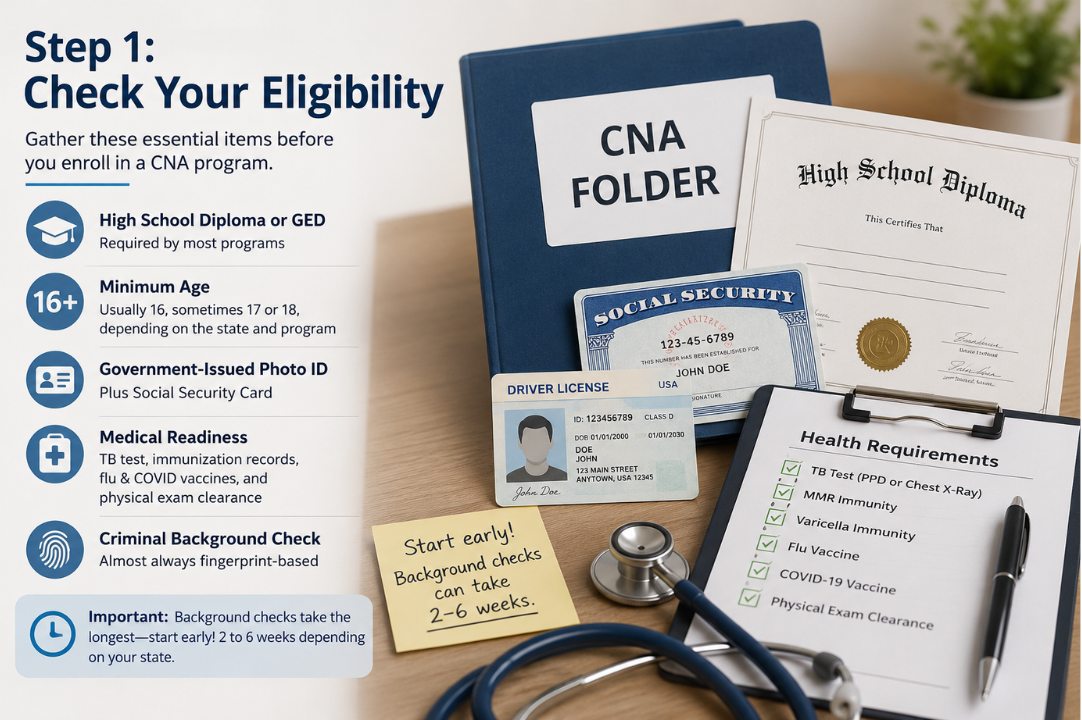
Before you spend a dollar on tuition, build a “CNA folder” with the paperwork every program will ask for. Most of these are non-negotiable, and a few take longer to process than you might expect. Most CNA programs will have a website that tells you the requirements you will need to begin their program.
What to gather:
- High school diploma or GED. Required by most programs, though there is an increasing number of high schools that offer CNA training, allowing certification upon high school graduation.
- Minimum age. Usually 16, sometimes 17 or 18, depending on the state and the program.
- Government-issued photo ID and Social Security card.
- Medical readiness paperwork. A recent TB test (PPD or chest X-ray), proof of MMR and varicella immunity, current flu and COVID vaccinations (school- and facility-specific), and a basic physical exam clearance.
- Criminal background check. Almost always fingerprint-based.
Important: Fingerprint background checks are the most common source of delay in this entire process. They clear in two weeks in some states and take up to six weeks in others. Start this step the same week you start researching programs, not after you enroll. If you have any past convictions that might affect eligibility, contact your state’s Board of Nursing or Department of Health directly before you pay tuition. Most programs cannot give you a refund once class begins.
Step 2: Choose Your Training Path
You have three main options for training, and they vary substantially on cost, speed, and what happens after you graduate.
| Path | Typical Cost | Typical Length | Job Placement | Best For |
|---|---|---|---|---|
| Community college | $800 to $2,000 | 6 to 12 weeks | Some career services support | Career-changers who want campus resources and a college transcript that may transfer toward LPN or RN credit later |
| Private vocational school | $500 to $1,500 | 4 to 8 weeks | Variable; many partner with local facilities. Ask about their placement rate | Candidates with flexible schedules who want the fastest classroom-based path |
| Facility-based (employer-sponsored) | Free to $200 | 4 to 8 weeks | Built-in (you usually agree to work there for 6 to 12 months) | Candidates willing to commit to a specific employer in exchange for free training |
The facility-based path is the open secret of CNA training, and the most common pathway toward certification. Nursing homes, long-term care companies, and large hospital systems frequently sponsor candidates through their own state-approved programs in exchange for a short employment commitment. If saving money and walking straight into a job matters more to you than program flexibility, this path is hard to beat.
Another rapidly growing option is training through local high schools. As of May 2026, there are 45 states that allow CNA training to be taught in high school. Each state has different requirements, such as CNA training that can be completed while in high school but with the certification exam delayed until after high school graduation. The availability of high school programs is still limited. The best resource to see if there is a high school in your area is to check your state’s education or workforce website to search for CNA high school programs.
Important: No matter which path you choose, verify that the program is approved by your state’s Board of Nursing or Department of Health before you enroll. An unapproved program will not qualify you to take the certification exam, no matter how good the instruction is. Each state publishes its current list of approved programs on its nursing board website. Look there first, then look at the program’s marketing materials, not the other way around.
Step 3: Complete the Training
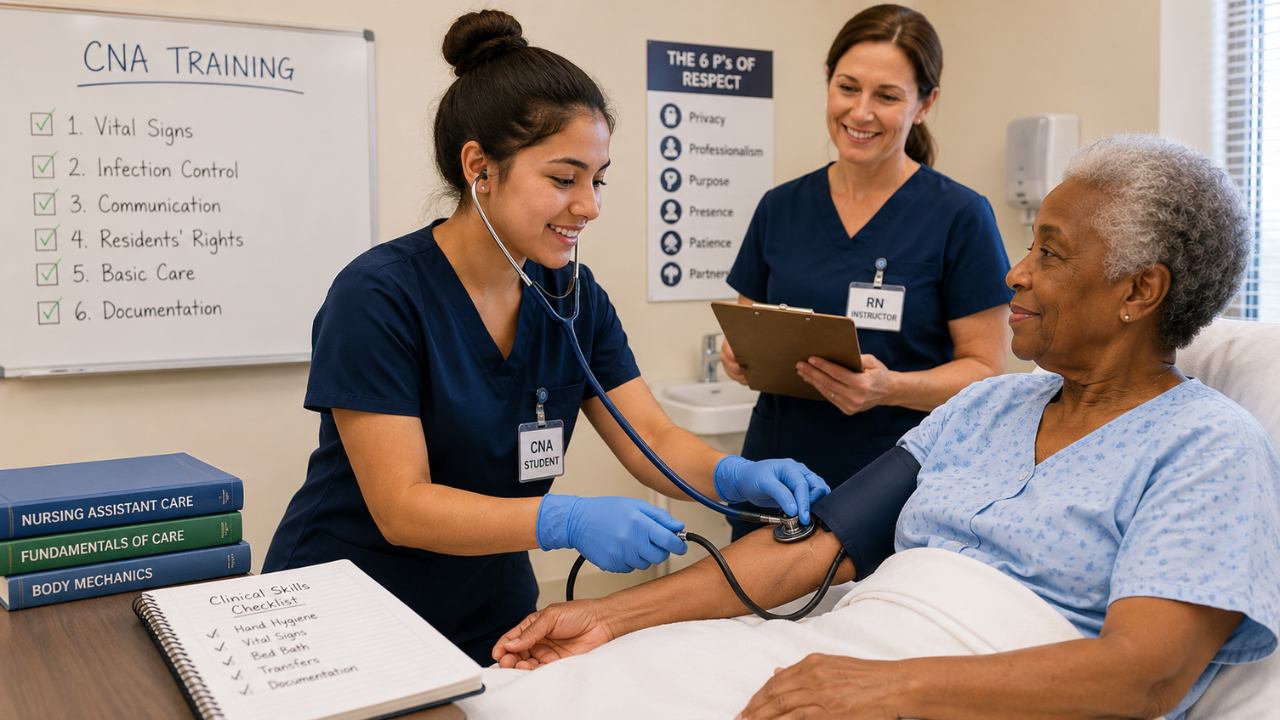
Federal law requires a minimum of 75 hours of training for any CNA program, but most states require more. Common state minimums fall between 75 and 175 hours, split between classroom instruction and supervised clinical practice.
The classroom side covers anatomy and physiology basics, infection control, communication, residents’ rights, medical terminology, vital signs, and the principles of basic care. The clinical side puts you in a real facility, in scrubs, under the supervision of a registered nurse instructor. You will have hands-on experience taking vital signs, providing daily care, and documenting.
A practical way to think about clinicals: treat the rotation like a 100-hour job interview. Many CNA students are hired by the facility where they completed their clinical rotation, often before they have even passed the certification exam. Your instructor sees how you handle yourself; the staff nurses see how you interact with residents; the unit manager watches for which students show up early, finish without being asked, and treat residents with dignity. People notice.
A few practical tips for clinicals:
- Show up 15 minutes early every day. It costs you nothing and signals reliability faster than anything you can say.
- Volunteer for the unwanted assignments. A bed change with a heavy resident, a difficult feeding, a confused new admission. The staff will remember.
- Ask questions of the floor nurses, not just your instructor. They are the ones who will recommend you for a job.
- Treat your instructor’s checklist as the minimum, not the maximum. If you finish your assigned task and a resident’s call light is on, answer it.
Step 4: Pass the CNA Exam
The CNA certification exam comes in two parts, and you have to pass both. Most states administer the exam through one of a few national vendors (Credentia, Prometric, HD Master, and a small number of others), with the specific vendor determined by your state’s testing contract.
The written (or oral) exam. There are 60 to 75 multiple-choice questions covering the same material as your classroom training. You have about 90 minutes. The questions are scenario-based: a resident does X, what do you do?
The clinical skills exam. This is the part most candidates worry about. You will perform three to five randomly selected skills (handwashing is almost always one of them) in front of an examiner who scores you against a checklist. You will complete all the skills within 30 to 45 minutes, depending on the number of skills you are asked to complete.
The Critical Steps. In most states, certain safety errors result in an automatic fail regardless of how well you performed the rest of the skill:
- Washing your hands at the start of the procedure1
- Identifying the resident before you begin1
- Explaining what you are about to do1
- Providing privacy1
- Locking the wheelchair brakes or bed wheels before any transfer1
- Lowering the bed when you are finished1
- Washing your hands again at the end1
¹These are commonly listed as critical steps in state skills checklists. Missing any one is treated as a safety failure that ends your exam, even if every other part of the skill was performed perfectly.
To prepare, schedule 30 to 60 minutes of practice every day in the two weeks leading up to your exam date. Free practice questions are widely available online. The testing vendor sites publish current candidate handbooks with the official skills checklists, which is the single best free study resource for the clinical exam.
Note: Vendor assignments can change because state testing contracts are re-bid every few years. The American Red Cross, which used to administer testing in several states, has been almost completely phased out since 2023; any testing still carrying the Red Cross name today is administered by Prometric. Always confirm your state’s current vendor in your state’s nurse aide candidate handbook before you start studying.
Step 5: Apply for the Registry
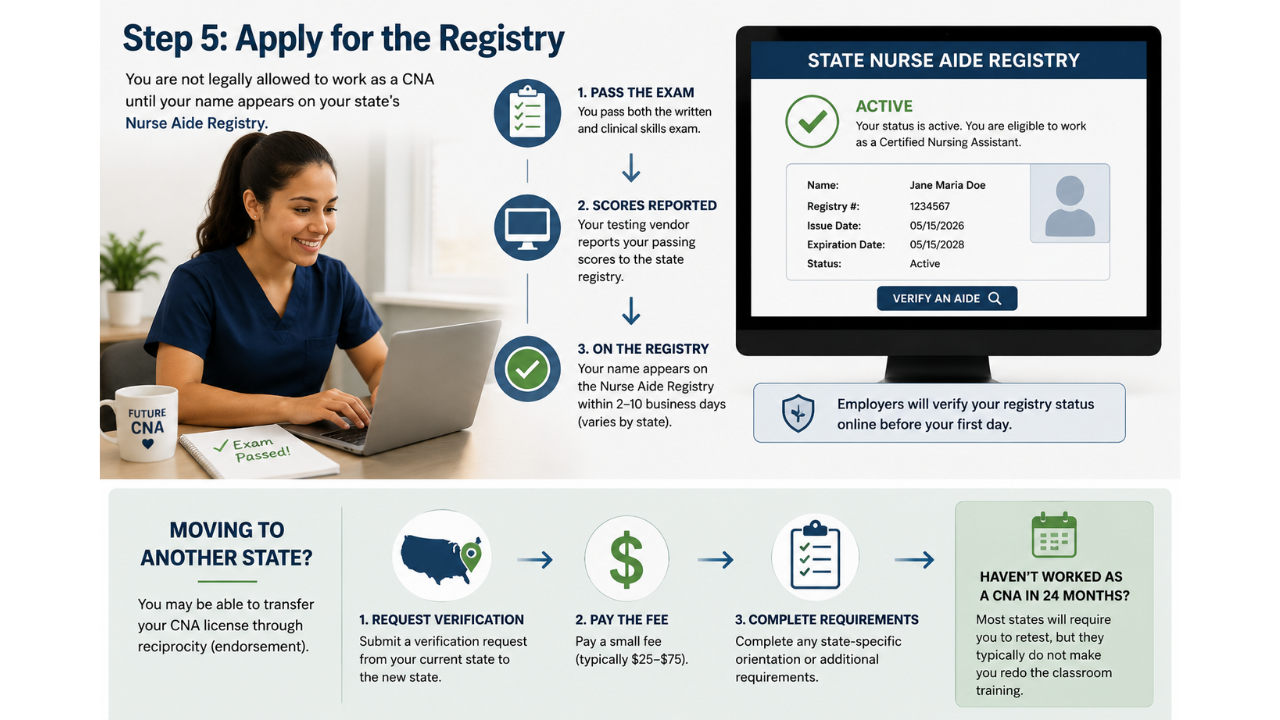
Passing the exam is not the same as being certified. You are not legally allowed to work as a CNA until your name appears on your state’s Nurse Aide Registry.
In most states, your testing vendor automatically reports your passing scores to the registry, and your name appears within 2 to 10 business days. A few states require you to submit an application separately. Check your state’s specific process; the testing vendor’s confirmation email usually spells it out.
Once you are on the registry, you can begin paid work as a CNA. Your registry status is searchable online, and any future employer will verify it before your first day.
Moving to another state? You do not always have to retrain. Most states recognize CNA licenses from other states through a process called reciprocity (sometimes called endorsement). Requirements vary, but in general, you submit a verification request from your current state to the new state, pay a small fee ($25 to $75), and complete any state-specific orientation. If you have not worked as a CNA in the last 24 months, most states will require you to retest, but they typically do not make you redo the classroom training.
What Comes Next
Your first 90 days on the job will look more like training than a “real” job, and that is normal. New CNAs typically shadow an experienced aide for the first week, take on a small assignment under supervision for the second, and gradually pick up a full resident load by the end of the first month.
Federal law requires a minimum of 12 hours of in-service or continuing education a year and 8 paid working hours every 24 months to keep your license active. Some states may require more in-service or continuing education, and some may also require the education to include specific topics such as dementia, infection control, and abuse prevention. It is best to find your state’s requirements on the state registry website. Your employer will usually track CE for you, but the responsibility for staying current is yours.
The CNA license is also a strong on-ramp. Many of the LPN and RN programs you may be considering down the road give credit for CNA experience and a small number of program hours, and some employers will help pay for nursing school once you have been on staff for a year. Whether you stay in long-term care, move into a hospital setting, or use the credential as the first rung of a longer nursing-school path, the work you do over the next 90 days will shape what comes after it.
Practice questions are one of the most efficient ways to lock in what you learned in training and stay sharp through the exam process. All Healthcare Careers offers free CNA practice tests that match the format and content focus of the current state exams. They are the closest you can get to the real thing without sitting for it.