
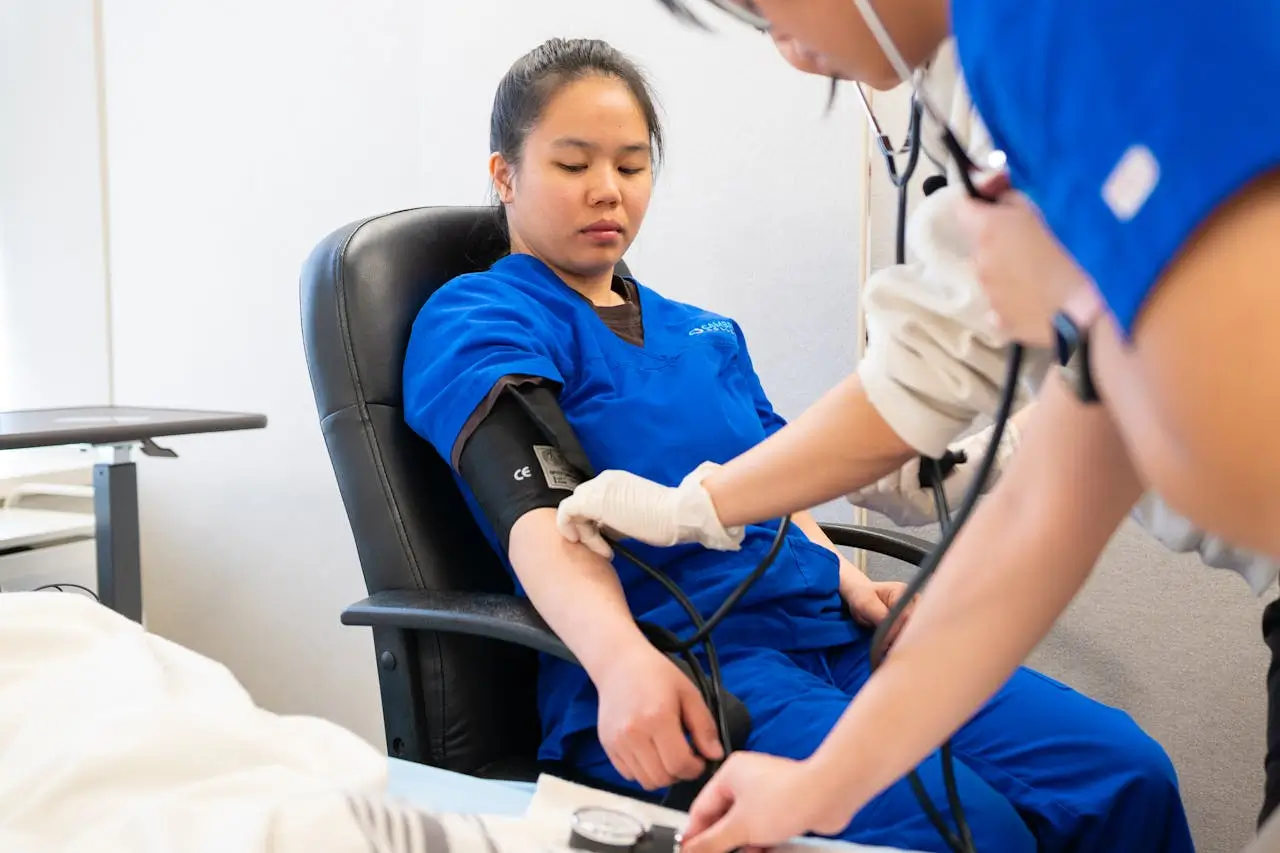
Once you have completed your CNA training program, the nurse aide certification exam is the final step before you begin working. The written portion is one part of the exam; the skills test is the other. For the skills portion of the exam, you will be asked to demonstrate 3 to 5 nursing skills in front of an evaluator. Most students find the skills portion more nerve-racking than the written exam because it is performed live and observed in real time.
This guide walks through 10 practical steps to help you prepare and feel confident to take the skills exam. Every step will be a reminder of what you learned in your CNA program.
What to Expect on the Skills Test
You will be tested on 3 to 5 randomly selected skills from a state-approved skills checklist. The list varies by state and examination board, but you will be expected to be fluent in any skill that could be assigned.
Handwashing is the one skill you can count on. Every state and board includes it on the test, and a serious error in handwashing will cause automatic failure. Infection control is a core safety priority and the evaluators take it that way.
You will demonstrate each skill on a live volunteer acting as a resident. Personally invasive skills, such as perineal care, are demonstrated on a mannequin part with the live actor reacting as expected from a resident. Expect the evaluator to watch quietly, take notes, and ask few or no questions during the demonstration.
You will have 30 to 45 minutes for the entire skills exam. You will be given instructions at the start of the exam that include the skills you must complete. The skills are completed one after another in one session, beginning with handwashing.
The 10 Steps
Step 1: Know every skill on your state’s checklist
You will not know in advance which skills you will be asked to demonstrate. You should be prepared to complete any skill you learned in your program. All states have a minimum core set of required skills for certification. Any additional skills needed can be found in your state’s nurse aide certification handbook.
The required CNA skills will cover 5 skill domains:
- Vital signs and measurements: radial pulse, respirations, blood pressure (manual cuff), body temperature, urinary output from a catheter bag
- Hygiene and personal care: handwashing, partial bed bath, oral care on a conscious and an unconscious resident, perineal care, dressing a resident with a weak side
- Mobility and positioning: transfer to a wheelchair with a gait belt, ambulation with a gait belt, body positioning (supine, prone, lateral, Sim’s, Fowler’s)
- Feeding and elimination: feeding assistance, toileting with a bedpan, catheter care
- Range of motion exercises: shoulder, elbow, wrist, hip, knee, ankle
Important: Handwashing and indirect care behaviors (privacy, introducing yourself, explaining the procedure) are included on every exam. Forgetting or incorrectly performing either of these results in automatic failure. This is the most common reason students fail the skills test, so they deserve as much practice as the named skills themselves.
Step 2: Find a study method that fits how you learn
Different students retain skills differently. Three methods that work for most:
- Video demonstrations. Watching the skill performed correctly, then performing it yourself, is faster than reading a written procedure. The AHC YouTube channel and other instructor channels have demonstrations of each skill.
- Flashcards. Skill name on one side, key indirect-care steps and the critical performance points on the other. Useful for ten-minute reviews throughout the day.
- Practice with a partner. Whether it is a classmate, a friend, or a family member willing to play patient, performing the skill out loud with a person is the closest practice to the real exam.
Mix the methods. Watching alone is rarely enough; performing alone misses the verbal explanation; group practice without video reference might cause forgetting steps.
Step 3: Know your state and its examination board
Different states use different examination boards, and the format and skills list can vary between them. Credentia, Prometric, and HD Master handle testing for most of the country; some states handle exams directly through local university or community college boards.
Credentia and Prometric have standardized their testing on 5 skills. HD Master has 3 to 4 skills, but handwashing is not considered a separate skill; they treat it as part of every skill.
Find out exactly who administers the exam in your state before you start studying. The order of operations, the way skills are named, and the equipment provided can all vary.
| Examination Board | States Currently Using |
|---|---|
| HD Master | AZ, AR, CA, MA, MI, NJ, ND, OH, OK, OR, SD, WI |
| Credentia | AL, AK, CA, CO, GA, IA, MD, MN, MS, MT, NV, NH, NC, PA, RI, SC, TN, TX, VA, WA |
| Prometric | AL, CT, DE, FL, HI, ID, LA, NM, NY, OK, WY |
Some states use more than one examination board (California, for example). If your state is not listed, check your state’s nurse aide certification handbook; testing may be administered through a college or other regional body.
Note: Vendor assignments can change because vendors bid for state testing contracts. The American Red Cross, which used to administer testing in several states, has been almost completely phased out since 2023; any testing still carrying the Red Cross name today is administered by Prometric. Always confirm your state’s current vendor in your state’s nurse aide candidate handbook before you start studying.
Step 4: Get handwashing exactly right
Handwashing is the skill that appears on every test, and it is the skill where students most often lose points or fail. The evaluator is looking for a specific sequence: wet hands, apply soap, lather for the required time (typically at least 20 seconds), clean under the nails, dry from fingertips toward wrists, turn off the faucet with a paper towel, and dispose of the towel without contaminating clean hands.
Practice it daily until it becomes automatic. Wash your hands using the steps every time you wash them in the weeks before the exam. Routine practice will help you pass the handwashing skill confidently.
Step 5: Practice measurements until they are reflex
Vital signs and measurements show up on almost every skills test. Practice taking and recording each one until the muscle memory is there:
- Radial pulse for one full minute, two fingers (not thumb), at the wrist
- Respirations for one full minute, counted while pretending to take pulse so the resident does not consciously alter breathing
- Blood pressure with a manual cuff, both numbers within an acceptable range of the evaluator’s reading
- Body temperature with the right device for the route (oral, tympanic, axillary, temporal)
- Urinary output measured in milliliters from a graduated container
The most common mistake is rushing and recording an estimated number. Record exactly what you measure, even if it is unexpected.
Examiners have a specific measurement range they use to determine your accuracy. This allows some room for different readings between you and the examiner. The most common range allowances are:
| Skill | Typical Testing Allowance |
|---|---|
| Blood pressure | Within ±2 mmHg or ±4 mmHg (depending on vendor) |
| Radial pulse | Within ±2 to ±5 beats per minute |
| Respirations | Within ±2 to ±3 breaths per minute |
| Weight | Within 2 lbs |
Step 6: Run the full test scenario several times
In the week before the test, set aside 15 to 20 minutes a day to run through a complete skill start to finish. Practice every step:
- Knocking and introducing yourself*
- Identifying the resident*
- Explaining what you are about to do*
- Providing privacy*
- Washing your hands*
- Performing the skill itself
- Returning the resident to a safe position
- Cleaning up the supplies
- Washing your hands again*
- Reporting your findings to the nurse (if applicable)
*These are the critical steps. Missing any one of them is an automatic failure, regardless of how well you performed the skill itself.
The skill itself is only part of what is being evaluated. The indirect-care steps around it (privacy, communication, handwashing before and after, safe positioning) are scored separately and are an automatic failure.
A few practical tips from real test-day experience:
- Talk through your skills out loud. The examiner can better understand what you are doing (for example, feeling for a pulse versus counting respirations).
- If you make a mistake or forget a step, tell the examiner what you should have done while you are completing the skill. If it is not a critical step, you will lose points but not fail.
- Patient safety must not be forgotten. Lock wheels, lower beds, and raise bedrails as needed.
- Anything that touches the floor is contaminated. You must replace it.
Step 7: Dress and present yourself for the test
How you present yourself affects how you feel and how the evaluator reads you. On test day:
- Clean, pressed scrubs in your school’s color
- Closed-toe clinical shoes
- Short, clean fingernails (no polish, no acrylics)
- Long hair tied back
- No dangling jewelry or large rings
- A watch with a second hand (needed for pulse and respirations)
Most testing sites publish a dress code in advance. If they do, follow it exactly. If they do not, the list above is the safe default.
Step 8: Read every instruction carefully
At the testing site, you may be given a list of the 3 to 5 skills you will be asked to demonstrate. Slow down and read each one twice. Make sure you understand which skill is being asked and which side of the resident’s body it applies to (some skills specify left or right). Re-read the indirect-care expectations.
Rushing through the instructions is one of the most common causes of an avoidable failure.
Step 9: Ask your questions before testing begins
You can usually ask the evaluator clarifying questions before the test starts, but not during. Use that window. Ask about anything you are unclear on: the layout of the testing space, where supplies are located, whether a particular piece of equipment is available, or whether a skill name on your sheet matches the procedure you practiced.
Once the test begins, you are working alone.
Step 10: Arrive early and stay calm
Arrive 20 to 30 minutes before your test time. Eat a real meal that morning, drink water, and bring your photo ID and any documentation your state requires. Use the last few minutes to review your handwashing sequence and your indirect-care steps, not to cram new content.
Test-day nerves are normal. They tend to peak right before you start and settle once you are in the first skill. Trust the practice you have already put in.
Day-of Test Quick Checklist
The morning of:
- Photo ID and any required documents in hand
- Clean scrubs, clinical shoes, hair tied back, no jewelry
- Watch with a second hand
- A small bottle of water and a snack for after
- 20 to 30 minutes of buffer time
In the testing room:
- Greet the evaluator and listen carefully to the orientation
- Read your skills list twice
- Ask any clarifying questions before the test starts
- Wash your hands before and after every skill
- Speak to the patient: introduce yourself, explain each step, provide privacy
Scoring and Passing Requirements
To pass the certification exam, you need to pass both portions:
- Skills portion: an 80 to 85% on the skills overall, with 100% on the critical steps
- Written portion: 70 to 75% (the written exam typically has around 65 questions)
The exact passing thresholds vary slightly by state and testing vendor, so confirm with your state’s candidate handbook.
After the Skills Test
You will usually find out whether you passed within a few days, sometimes the same day. If you pass, your name goes on your state’s nurse aide registry and you are eligible to work as a CNA. If you do not pass the first time, most states allow you to retake either the failed section or the whole exam.
A first-attempt failure is more common than students expect, and it is not the end of the path. Many CNAs who have long, successful careers needed a second attempt. If you have to retake, ask the evaluator (or the candidate handbook) which specific skill or step you failed, and target your practice there.
A Practice Test Helps Both Sections
Most CNA candidates focus their preparation on the skills portion because it feels higher-stakes in the moment, but the written portion has its own pace and pattern that takes practice to get used to. Working through CNA practice questions in the weeks before your exam helps you build the test-taking rhythm, get comfortable with the multiple-choice format, and surface any topic areas where your knowledge has gaps.
All Healthcare Careers offers a free CNA practice test that mirrors the real exam format. If you have a few weeks before your test date, working through it once and reviewing the explanations is one of the most efficient ways to study for the written portion.